
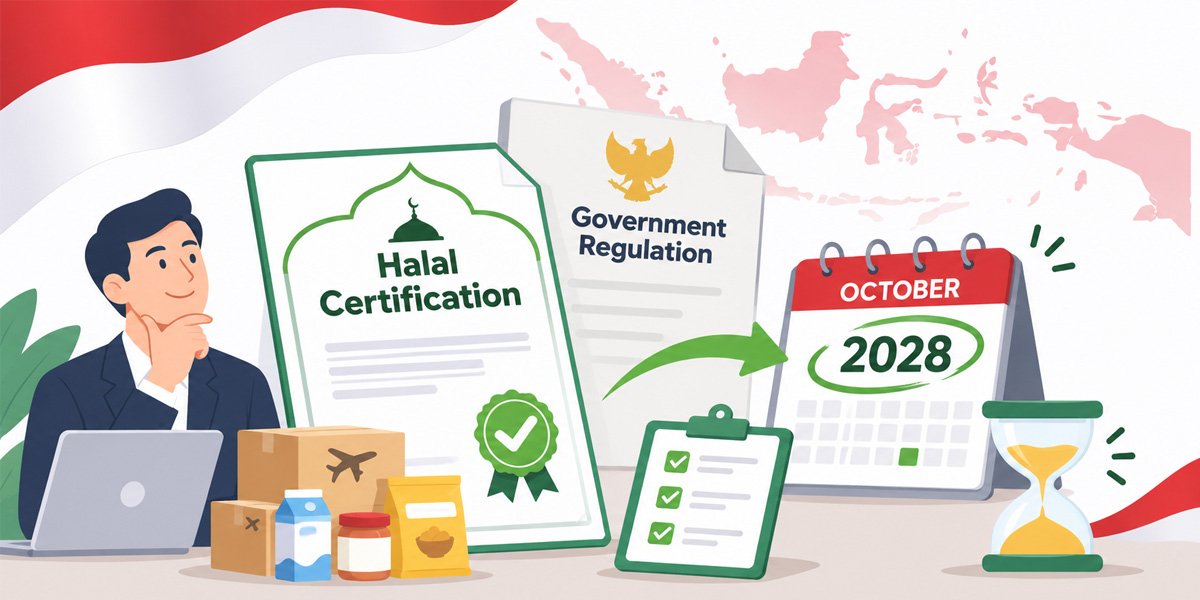
The Indonesian Government has issued Government Regulation (PP) No. 40 of 2026, amending Government Regulation No. 42 of 2024 concerning the Implementation of Halal Product Assurance.
The regulation was enacted and promulgated on October 14, 2026.
One of its major changes is the adjustment of the phased implementation period for mandatory halal certification for certain product categories until October 17, 2028.
This change does not eliminate the mandatory halal certification requirement.
Instead, it adjusts the implementation timeline according to the relevant product category and business classification.
1. Why Was the Halal Certification Timeline Adjusted?
According to the General Elucidation of Government Regulation No. 40 of 2026, the Government considered the readiness of business operators and the capacity of Indonesia’s Halal Product Assurance (JPH) ecosystem.
Several factors were taken into consideration, including:
- Capacity of Halal Inspection Bodies (LPH)
- Availability of Halal Auditors
- Availability of Halal Product Process Assistants (PPH)
- Availability of supporting infrastructure
- Readiness of the halal supply chain
- Readiness of mutual recognition arrangements for halal certificates with partner countries
The adjustment is intended to allow mandatory halal certification to be implemented more effectively and gradually.
It is also intended to provide greater legal certainty for both consumers and business operators.
2. Which Product Categories Are Affected?
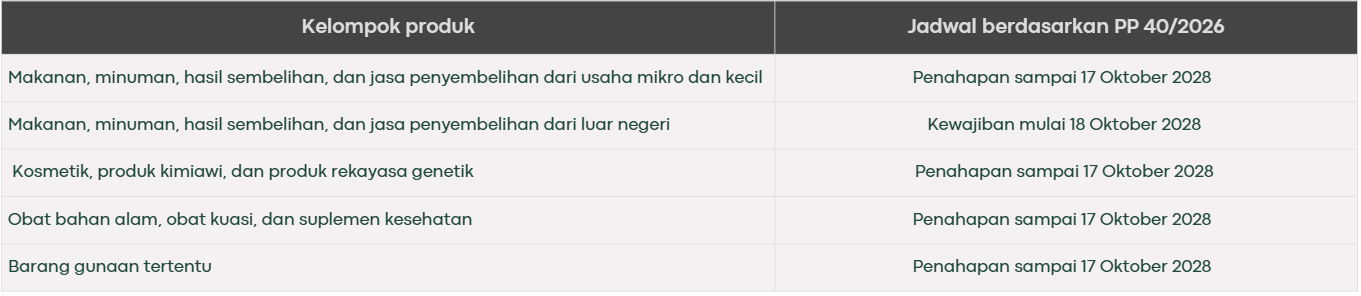
Government Regulation No. 40 of 2026 does not apply the October 2028 adjustment uniformly to all products.
Several categories whose implementation periods are adjusted until October 17, 2028 include:
- Food, beverages, slaughtered products, and slaughtering services produced or provided by micro and small enterprises
- Certain services related to food, beverages, and slaughtered products
- Food, beverages, slaughtered products, and slaughtering services originating from overseas
- Traditional medicines
- Quasi-drugs
- Health supplements
- Cosmetics
- Chemical products
- Genetically engineered products
- Certain consumer goods
- Class A medical devices
For food, beverages, slaughtered products, and slaughtering services originating from overseas, the mandatory halal certification requirement begins on October 18, 2028, taking into account the completion of mutual recognition arrangements for halal certificates.
However, not all product categories have been extended until 2028.
Other products continue to follow different timelines under Articles 160 and 161.
These include categories such as:
- Over-the-counter and limited over-the-counter medicines
- Class B medical devices
- Prescription medicines, excluding psychotropic substances
- Class C medical devices
Therefore, business operators need to identify their specific product category before determining the applicable halal certification deadline.
3. What Is the Impact on LPPH for Imported Products?
Government Regulation No. 40 of 2026 also introduces an important change concerning halal products originating from overseas.
Article II point 1 letter b provides that provisions concerning the conformity assurance of foreign halal products entering the territory of Indonesia, as regulated under the relevant implementing regulations, are revoked and declared no longer applicable.
This provision affects the regulatory framework that had previously governed the conformity assurance mechanism for imported halal products.
Therefore, discussions concerning the Laporan Pemastian Produk Halal (LPPH) or similar conformity assurance mechanisms need to be understood in the context of the regulations that applied before the issuance of Government Regulation No. 40 of 2026.
In other words, importers should not rely solely on the previous conformity assurance procedure when determining their current obligations.
However, this regulatory change does not eliminate other import requirements.
Imported products must still comply with applicable regulations concerning:
- Customs
- Trade
- Product licensing
- Halal certification and registration, where applicable
- Other sector-specific requirements
The implementation of imports from overseas therefore continues to follow the applicable customs and trade regulations.
4. What Does This Mean for Imported Products?
The adjustment provides additional preparation time for certain imported product categories.
For food, beverages, slaughtered products, and slaughtering services originating from overseas, mandatory halal certification is scheduled to begin on October 18, 2028.
The implementation also takes into account the completion of cooperation and mutual recognition arrangements for foreign halal certificates.
This means that manufacturers, exporters, importers, and overseas halal certification bodies have additional time to prepare for the applicable Indonesian halal requirements.
Nevertheless, businesses should continue monitoring:
- Recognition of foreign halal certificates
- Registration requirements in Indonesia
- Product-specific halal certification requirements
- Import licensing
- Customs requirements
- Further BPJPH implementing regulations
5. Mandatory Halal Certification Has Not Been Eliminated
It is important to understand that Government Regulation No. 40 of 2026 does not abolish Indonesia’s mandatory halal certification policy.
The regulation primarily adjusts the phased implementation schedule for certain categories.
The obligation remains in place, but the applicable deadline depends on:
- Type of product
- Business scale
- Product origin
- Risk classification, particularly for medical devices
- Other provisions established under the Halal Product Assurance framework
Businesses should therefore use the additional transition period to prepare their products, documentation, production processes, supply chains, and halal certification strategies.
Conclusion
Government Regulation No. 40 of 2026 provides a longer preparation period for several product categories and allows the Government to strengthen the readiness of Indonesia’s Halal Product Assurance ecosystem.
For certain categories, the phased mandatory halal certification period has been extended until October 17, 2028.
For certain foreign products, the obligation begins on October 18, 2028.
The adjustment does not remove the halal certification requirement.
Instead, it creates different implementation schedules according to product categories and business conditions.
The regulation also changes the framework for the conformity assurance of foreign halal products entering Indonesia, meaning that previous mechanisms related to imported halal product conformity need to be reviewed against the latest regulation.
For information about the mechanism that applied before this regulatory update, refer to AR-TEK’s previous article on LPPH for Imported Products 2026.
Regulatory References
- Government Regulation No. 40 of 2026 concerning the Amendment to Government Regulation No. 42 of 2024 on the Implementation of Halal Product Assurance, particularly Articles I and II and the General Elucidation.
- Government Regulation No. 42 of 2024 concerning the Implementation of Halal Product Assurance.
- BPJPH Regulation No. 4 of 2026 concerning the Conformity Assurance of Foreign Halal Products Entering the Territory of Indonesia, as a reference to the regulatory framework that applied before the amendment.