
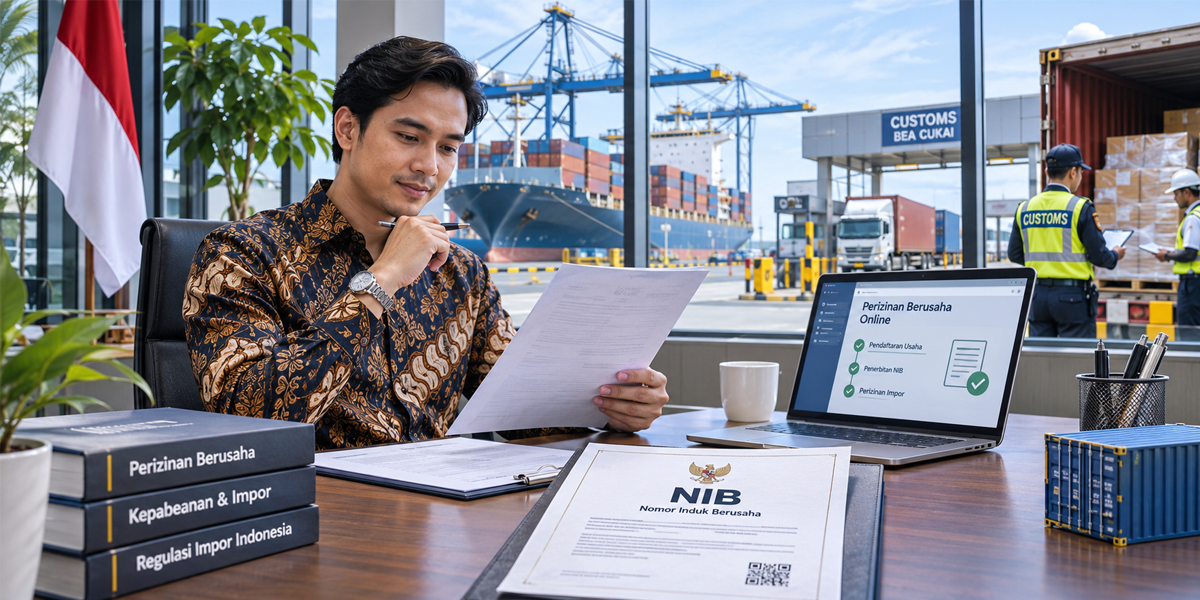
The establishment of the OSS system allows business operators to obtain an NIB as an identity that can be used for various licensing processes.
However, many business operators still do not fully understand this process.
As a result, many businesses continue to experience administrative difficulties.
Through this article, you will learn what an NIB is, its functions, and the steps required to obtain one.
Let’s take a closer look.
What Is an NIB?
A Business Identification Number (Nomor Induk Berusaha/NIB) is an identification number for business operators based on their field of business, as regulated under the 2020 Indonesian Standard Industrial Classification (KBLI).
The classification distinguishes businesses according to the type of economic activity that produces outputs in the form of goods or services.
An NIB serves as proof of registration for business operators to conduct business activities and as an official identity for carrying out those activities.
The Online Single Submission (OSS) institution under the Ministry of Investment/BKPM is the official government institution responsible for issuing NIBs.
An NIB consists of 13 random digits, includes security features, and is equipped with an electronic signature.
An NIB must be obtained by both newly established businesses and businesses that had already been operating before the implementation of the OSS system.
Functions of an NIB
An NIB provides business operators with greater convenience in administrative and business licensing processes.
This is because an NIB also functions as:
- Company Registration Certificate (TDP)
- Import Identification Number (API), if the business conducts import activities
- Customs Access, if the business conducts export and import activities
Business operators no longer need to separately process several business licensing documents, such as:
- TDP
- IUI
- SIUP
By using an NIB, these licensing requirements are already handled because the NIB replaces these documents for operational and commercial licensing purposes.
In accordance with Article 12 of Law No. 11 of 2020 concerning Job Creation, Risk-Based OSS was implemented based on Government Regulation of the Republic of Indonesia No. 5 of 2021 concerning Risk-Based Business Licensing.
As of August 2021, the government changed the OSS v.1.1 system into the Risk-Based OSS system, as regulated under BKPM Regulation No. 3 of 2021.
The implementation of risk-based business licensing focuses on improving the investment ecosystem and business activities in Indonesia through a simpler and more effective licensing process.
Risk-Based Business Activities
The implementation of risk-based business licensing is divided into two major categories:
- Micro and Small Enterprises (UMK)
- Non-UMK Enterprises
In this case, UMK refers to businesses owned by Indonesian citizens, either individually or through business entities, with a maximum business capital of IDR 5 billion, excluding land and buildings used as business premises.
Both conventional and online MSMEs are included in the UMK category.
Non-UMK enterprises are divided into several categories:
- Medium Enterprises — Businesses with capital ranging from IDR 5 billion to IDR 10 billion.
- Large Enterprises — Business entities owned by Domestic Investors or Foreign Investors with business capital exceeding IDR 10 billion.
- Representative Offices — Individuals or business entities representing foreign business operators that have received approval to establish offices in Indonesia.
- Foreign Business Entities — Foreign business entities established outside Indonesia that later open businesses and/or conduct activities in Indonesia.
OSS is implemented using a risk-based approach with several levels based on an assessment of:
- Potential hazards
- Level of hazard
- Level of risk
Licensing standards are applied according to the following risk levels.
1. Low Risk
For low-risk businesses, the NIB serves as the identity of the business operator and as proof of a single business licensing legality.
2. Medium-Low Risk
For medium-low risk businesses, NIB and Standard Certificate serve as the required licenses and legal basis for conducting business activities.
The Standard Certificate is issued in the form of a self-declaration using a format provided through the Risk-Based OSS system.
The license can be used during business preparation and throughout the operational and commercial activities of the business.
3. Medium-High Risk
For medium-high risk businesses, NIB and Standard Certificate must also be obtained.
However, these documents only function as business legality.
Operational and commercial licensing requires verification of compliance with the Business Activity Implementation Standards by the Regional Government or Central Government.
4. High Risk
For high-risk businesses, business operators must obtain both an NIB and a License.
The government license is granted to allow business operators to conduct operational and commercial activities.
In addition, verification of compliance with the Business Activity Implementation Standards from the Central or Regional Government is also required in the form of a certificate.
Steps to Obtain an NIB
The following are the general steps for obtaining an NIB:
- Log in to the OSS system.
- Complete the required information. If the business operator employs foreign workers, the business operator must agree to appoint accompanying Indonesian workers and provide education and training or submit the required declaration.
- Enter information regarding the business activity based on the 5-digit KBLI code.
- Check the confirmation box as evidence of approval regarding the accuracy and validity of the submitted information.
- Obtain the NIB and other registration documents.
As a note, all licenses will only be activated and become effective after the required licensing commitments have been fulfilled and the applicable licensing fees have been paid.
These fees may include:
- PNBP
- Levies
- Other fees in accordance with applicable regulations
Import Licensing Document Services with PT. Alpha Romeo Teknologi
For those planning to obtain legal documentation for imported products, PT. Alpha Romeo Teknologi can assist you.
With experience in processing import-related documents, PT. ART is ready to help simplify your import process.
It is time to focus on your business while we handle the administrative process.
Contact us now for a consultation.