

In the telecommunications sector, the use of radio communication has become common in society.
Radio communication equipment operates on various frequency bands, ranging from very low frequencies to very high frequencies.
As technology continues to develop, radio devices in Indonesia are required to comply with applicable technical standards to ensure interoperability and prevent interference between devices.
High-frequency radio communication equipment refers to radio communication equipment and/or devices that function as transmitters and receivers (transceivers) operating in the HF, VHF, and UHF frequency bands according to the allocation tables for those frequency ranges.
HF, VHF, and UHF communication radios are generally used for radio stations in terrestrial radio communication services, including Amateur Radio stations and community radio communication.
The devices may be available in the form of:
- Mobile devices such as Handy Talkies
- Fixed devices such as RIG radios
The following section explains the differences between HF, VHF, and UHF radio bands :
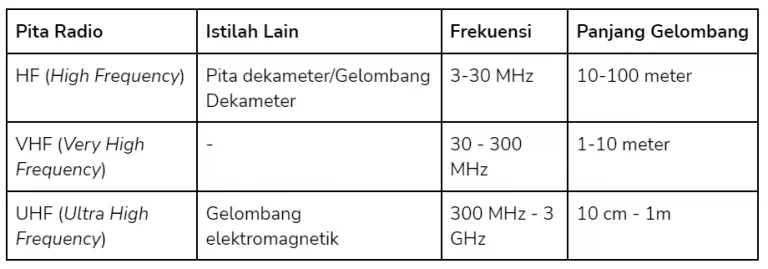
HF Radio
HF Radio is generally used for shortwave broadcasting stations operating at 2.310 – 25.820 MHz, aviation communications, government time services, and amateur radio.
VHF Radio
VHF Radio is commonly used for:
- FM radio broadcasting
- Television broadcasting
- Land mobile radio communication for emergency, business, and military purposes
- Long-distance data communication using radio modems
- Amateur Radio
- Maritime communication
- Air traffic control communication
- Air navigation systems
UHF Radio
UHF Radio is generally used for:
- Mobile phones
- Radio broadcasting
- Amateur radio operators
- GPS (Global Positioning System)
- Radio frequency identification
HF, VHF, and UHF technologies are included among the technologies that require certification.
The equipment and/or devices must comply with the technical standards stated in:
- Directorate General Regulation (PERDIRJEN) POSTEL No. 171/DIRJEN/2009
- KEPDIRJEN POSTEL No. 84/DIRJEN/1999
The following are several general technical standard requirements that you should know.
General Technical Requirements
1. General
- Display unit
- Button unit
- Microphone unit
- Connection
2. Power Supply
3. Operating Frequency
4. Transmitter Output Power
5. Modulation
6. Stability
7. Channel Spacing
8. RF Impedance
9. Room Temperature
10. Frequency Deviation
In addition to the technical standards, there are also requirements related to testing, marking, and packaging.
The explanation above provides a brief overview of the Technical Standards for HF, VHF, and UHF Telecommunication Equipment and/or Devices.
We hope this information is useful for you.
Are you ready to apply for Postel/SDPPI certification? Contact us today for more information.