

For applicants applying for SDPPI/Postel certification, the term technical standards or technical requirements for telecommunication equipment and/or devices is probably already familiar.
However, do you fully understand what these technical standards mean?
If you are planning to apply for Postel certification, you may have already started looking for information about the applicable technical standards for telecommunication equipment and devices.
Through this article, we will explain the technical standards applicable to telecommunication equipment and/or devices, as well as several important points you need to understand.
Let’s take a closer look.
What Are Technical Standards?
Technical Standards are technical requirements for telecommunication equipment and/or devices covering aspects such as:
- Electronics
- Safety
- Health
- Security
- Environment
These standards apply to every telecommunication device operating in Indonesia.
Referring to Government Regulation No. 46 of 2021 concerning Postal Services, Telecommunications, and Broadcasting, technical standards are implemented for several purposes.
1. Protecting the Public from Potential Losses
Technical standards are intended to protect the public from possible losses caused by the use of telecommunication equipment and/or devices.
For example, if you purchase telecommunication equipment from overseas without ensuring that it has been certified according to the applicable standards, there is a possibility that the device may not function properly in Indonesia.
2. Preventing Interference Between Telecommunication Devices
Indonesia assigns specific radio frequency spectrum ranges for different types of telecommunication equipment and devices.
If a device does not comply with the applicable standards, it may interfere with the operating frequencies of other devices.
For this reason, technical standards are used to help prevent harmful interference between telecommunication equipment.
3. Ensuring Connectivity Within Telecommunication Networks
Telecommunication equipment and devices that comply with the applicable specifications and technical standards are expected to work properly with other equipment and networks operating in Indonesia.
This helps ensure connectivity and compatibility within telecommunication networks.
4. Supporting the Development of the National Telecommunications Industry
Technical standards also aim to encourage the development of:
- Industry
- Innovation
- Engineering
- National telecommunication technology
As technology continues to develop, more telecommunication equipment and devices will be introduced and used in Indonesia.
Technical standards help the government, manufacturers, and consumers understand and adjust to the development of these technologies.
Who Establishes the Technical Standards?
Technical standards for telecommunication equipment and devices fall under the authority of the Ministry of Communication and Information Technology, particularly through:
- Directorate General of SDPPI
- Directorate General of PPI
Technical standards are established by the Minister and the relevant Directorate General.
These standards may be issued in the form of:
- Ministerial Decrees (Keputusan Menteri/Kepmen)
- Director General Regulations (Peraturan Direktur Jenderal/Perdirjen)
Technical standards are continuously updated to reflect technological development and the needs of certification applicants in Indonesia.
If certain telecommunication equipment and/or devices do not yet have specific technical standards, the Ministry of Communication and Information Technology, particularly the Directorate General of SDPPI, may formulate the standards through three approaches.
These include:
Adoption
Adopting international or regional standards.
Adaptation
Adapting international or regional standards to suit conditions and requirements in Indonesia.
National Development
Developing standards based on the results of national industry development, innovation, and telecommunication technology engineering.
Under certain circumstances, the Minister may approve the use of international standards for telecommunication equipment and/or devices that do not yet have specific technical standards.
This provision is stated in Article 37 paragraph (3) of Government Regulation No. 46 of 2021.
Prohibition on Modifying Certified Equipment
Telecommunication equipment and/or devices intended for use in Indonesia must first be checked for compliance with the applicable technical standards.
These technical standards are used as a reference during the certification process for telecommunication equipment and/or devices.
Certification is subject to the applicable certification fees.
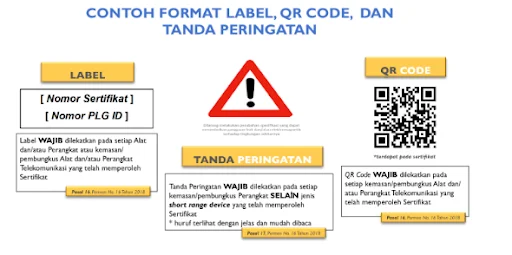
Once certified, the equipment must carry the required certification label attached to the telecommunication device.
The label serves as an indication that the equipment and/or device complies with the applicable technical standards.
If a manufacturer or certification applicant makes modifications to the certified equipment and/or device, the device must undergo re-certification to ensure that it continues to comply with the applicable technical standards.
The latest technical standard references can be checked through the SDPPI Postel Certification website or through the Regulations menu on www.postel.go.id.
As an example, one of the technical standards that had recently been issued at the time referred to in this article was the Technical Standard for Free Space Optics Telecommunication Devices, regulated under Minister of Communication and Information Technology Decree No. 59 of 2022.
Administrative Sanctions for SDPPI Postel Certification
Companies, manufacturers, or distributors of telecommunication equipment and/or devices that violate certification requirements or fail to comply with the applicable certification provisions may be subject to administrative sanctions.
These sanctions may include:
1. Written Warning
A written warning may be issued up to three times.
Each warning may be issued within a maximum period of one month.
The authorities may also consider written responses and/or objections submitted by the applicant or business operator.
2. Administrative Fine
Business operators may be subject to an administrative fine.
3. Temporary Suspension of Business Activities
Certain business activities may be temporarily suspended.
4. Access Termination
Access related to the relevant service or activity may be terminated.
5. Police Enforcement Measures
Authorities may apply police enforcement measures as provided under the applicable regulations.
6. Service Revocation
The revocation applies to the specific type of operation or service that violated the applicable requirements.
It does not necessarily result in the revocation of other types of operations that are not related to the violation.
7. Revocation of Business Licensing
The relevant business license may also be revoked.
The procedures for imposing administrative sanctions are regulated under Director General Regulation No. 07 of 2021 concerning Procedures for Guidance, Supervision, and Imposition of Sanctions for Violations in the Use of Radio Frequency Spectrum and Telecommunication Equipment and/or Devices.
Ready to Apply for SDPPI Postel Certification?
By understanding the applicable technical standards, you can begin identifying the requirements that apply to the telecommunication equipment or devices you plan to certify.
This article provides a basic overview of technical standards for telecommunication equipment and/or devices.
Understanding these standards can help you prepare for the SDPPI/Postel certification process.
Still experiencing difficulties with the certification process?
Contact us for assistance with your Postel/SDPPI certification.