
The Indonesian Government issued Government Regulation of the Republic of Indonesia No. 43 of 2023 concerning the Types and Tariffs of Non-Tax State Revenue applicable to the Ministry of Communication and Informatics.
The regulation was issued on September 19, 2023 and covers various types of Non-Tax State Revenue (Penerimaan Negara Bukan Pajak/PNBP), including fees for issuing Telecommunication Equipment and/or Telecommunication Device Certificates.
In the DJID certification process, the applicable PNBP fee is not always the same for every application. The amount may vary depending on the device category and the type of Test Report (Laporan Hasil Uji/LHU) used to support the certification application.
Several factors may affect the applicable fee, including:
- Whether the device falls under the HKT or Non-HKT category
- Whether the test report comes from a domestic or overseas testing laboratory
- Whether an overseas laboratory falls under a Mutual Recognition Arrangement (MRA)
- Whether the certification application uses a combination of different test reports
Therefore, companies should identify the device category and review the status of their test reports before starting the certification process.
What Is PNBP for Telecommunication Device Certification?
PNBP, or Non-Tax State Revenue, is a payment collected by the government for certain services, resources, or rights provided by the state under applicable regulations.
For telecommunication equipment and device certification, PNBP applies to the issuance of the certificate.
The certificate confirms that a specific type of telecommunication equipment and/or device has met the applicable technical standards.
The certification fee applies per certificate and per device type.
As a result, if a company applies for certification for several different device types, it needs to calculate the PNBP fee for each certification application.
What Determines the PNBP Fee?
Government Regulation No. 43 of 2023 sets different certification fees based on the device category and the source or type of Test Report.
Several factors determine the applicable tariff.
1. HKT and Non-HKT Categories
For certification fee purposes, devices are divided into two main categories.
HKT refers to:
- Mobile phones
- Handheld computers
- Tablets
Meanwhile, Non-HKT covers telecommunication equipment and devices outside the HKT category.
This distinction is important because the use of overseas test reports may result in different PNBP fees for HKT and Non-HKT devices.
2. Domestic Test Reports
A Domestic Test Report is a test report issued by a testing laboratory in Indonesia according to the applicable requirements.
Using a domestic test report generally results in the lowest PNBP tariff compared with several overseas test report schemes.
3. Overseas MRA Test Reports
An Overseas MRA Test Report is a test report issued by an overseas laboratory whose testing results can be used under an applicable Mutual Recognition Arrangement (MRA).
An MRA is a mechanism for mutual recognition of conformity assessment results between Indonesia and its partners.
In telecommunication device certification, this mechanism may allow test results from certain overseas laboratories to be used when they meet the applicable requirements.
4. Overseas Non-MRA Test Reports
An Overseas Non-MRA Test Report comes from an overseas testing laboratory outside the applicable MRA mechanism.
Using this type of report may result in a higher PNBP fee.
However, companies still need to confirm whether the test report is acceptable under the current certification requirements.
5. Combined Test Reports
In some certification applications, companies may use more than one test report.
For example, one testing parameter may use a Domestic Test Report, while another parameter uses an Overseas Test Report.
This arrangement is referred to as a Combined Test Report or LHU Kombinasi.
The applicable PNBP fee then follows the category of the test report combination used in the application.
How Much Is the DJID Certification PNBP Fee?
Under Government Regulation No. 43 of 2023, the fee for issuing a Telecommunication Equipment and/or Telecommunication Device Certificate ranges from IDR 12 million to IDR 80 million per certificate per device type.
The following table provides an overview:
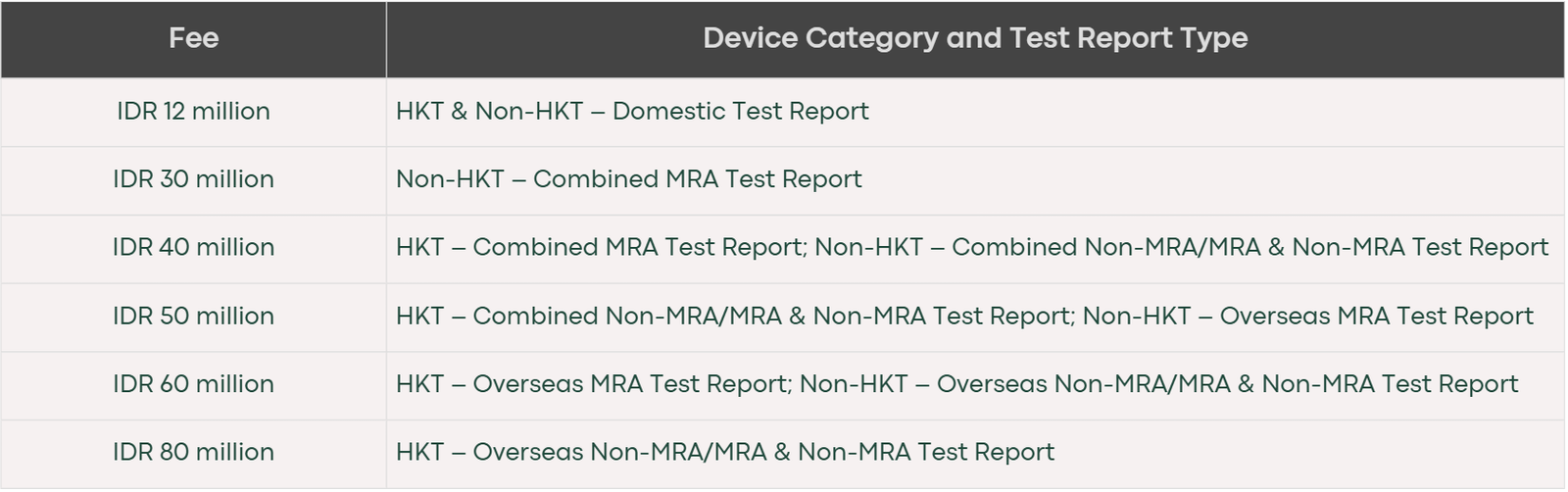
Therefore, two technically similar products may still have different certification fees if they fall under different device categories or use different test report sources.
Important Terms in the PNBP Fee Structure
To understand the table more easily, companies should know several key terms.
MRA
MRA (Mutual Recognition Arrangement) is a mechanism for mutual recognition of conformity assessment results between Indonesia and its partner countries or organizations.
For telecommunication device certification, MRA may cover the acceptance of test results from overseas laboratories that meet the applicable recognition requirements.
HKT
HKT is an Indonesian regulatory term covering:
- Mobile phones
- Handheld computers
- Tablets
The acronym comes from the Indonesian terms Handphone, Komputer Genggam, dan Tablet.
Non-HKT
Non-HKT refers to telecommunication equipment and devices that do not fall under the HKT category.
Examples may include:
- Routers
- Access points
- IoT devices
- Radio communication equipment
- Base stations
- Repeaters
- Certain modems
- Other telecommunication devices
However, the device category should still be determined based on the product characteristics and applicable regulations.
DN
DN (Dalam Negeri) means Domestic and refers to a Test Report issued by a testing laboratory in Indonesia.
LN
LN (Luar Negeri) means Overseas and refers to a Test Report issued by a testing laboratory outside Indonesia.
Combined Test Report
A Combined Test Report means that the certification application uses test reports from more than one source.
For example, a company may use a Domestic Test Report for one testing parameter and an Overseas Test Report for another parameter.
When Must the PNBP Fee Be Paid?
After the certification application is approved for payment, the system issues a Payment Notification Letter (Surat Pemberitahuan Pembayaran/SPP).
The SPP generally contains information such as:
- Certificate applicant
- Device brand and type
- Certification fee
- Payment deadline
- Billing or payment code
Under the applicable PNBP and telecommunication certification procedures, the applicant must pay the certification fee no later than 14 calendar days after the SPP is issued.
If the applicant does not complete the payment within this period, the certification application and SPP may be cancelled.
Therefore, companies should carefully monitor the payment deadline and make sure that the billing is paid within the required period.
Is the PNBP Fee the Same as the Testing Fee?
No.
This distinction is important because the PNBP certification fee and laboratory testing fee are separate costs.
The PNBP certification fee is a government fee related to the issuance of the Telecommunication Equipment and/or Telecommunication Device Certificate.
Meanwhile, the testing fee relates to laboratory testing required to obtain the Test Report.
Therefore, the total cost of certification may include:
- RF Testing fees
- EMC Testing fees
- SAR Testing fees, when required
- Electrical Safety Testing fees, when required
- Other technical testing fees
- PNBP certificate issuance fee
Testing costs may vary depending on the type of device, technologies, required parameters, and testing laboratory.
Can Companies Estimate the PNBP Fee Before Applying?
In many cases, yes.
However, the company first needs to identify:
- Device type
- HKT or Non-HKT category
- Technologies used by the device
- Available test reports
- Country of the testing laboratory
- MRA or Non-MRA status
- Testing parameters covered by each report
- Whether the application requires a combination of test reports
Without this information, the PNBP estimate may not be accurate.
For example, using an existing overseas test report may initially appear more practical. However, if the report falls under a Non-MRA category or needs additional testing, the applicable PNBP fee may be different.
Therefore, reviewing existing test reports before submitting a certification application is an important step in determining the most appropriate certification strategy.
How Does Government Regulation No. 43 of 2023 Relate to Current Certification Regulations?
Government Regulation No. 43 of 2023 provides the basis for PNBP tariffs for various government services that were under the Ministry of Communication and Informatics when the regulation was issued.
These services include the issuance of Telecommunication Equipment and/or Telecommunication Device Certificates.
The implementation of PNBP tariff determination in the postal and telecommunications equipment sector is further regulated under Minister of Communication and Informatics Regulation No. 9 of 2023.
Meanwhile, the operational requirements for telecommunication equipment and device certification are regulated under Minister of Communication and Informatics Regulation No. 3 of 2024 concerning Certification of Telecommunication Equipment and/or Telecommunication Devices.
Ministerial Regulation No. 3 of 2024 also refers to Government Regulation No. 43 of 2023 and Ministerial Regulation No. 9 of 2023 as part of its legal basis.
Therefore, the three regulations have different but related functions:
- Government Regulation No. 43 of 2023 sets the types and tariffs of PNBP.
- Ministerial Regulation No. 9 of 2023 provides implementing rules for determining PNBP tariffs.
- Ministerial Regulation No. 3 of 2024 regulates the certification process for telecommunication equipment and devices.
What Previous Regulation Did Government Regulation No. 43 of 2023 Replace?
When Government Regulation No. 43 of 2023 took effect, it revoked Government Regulation No. 80 of 2015 concerning the Types and Tariffs of Non-Tax State Revenue applicable to the Ministry of Communication and Informatics.
Therefore, companies should no longer use Government Regulation No. 80 of 2015 as the basis for calculating current telecommunication device certification PNBP fees.
Instead, businesses should refer to the applicable tariff regulations when submitting a certification application.
Important Checks Before Applying for Certification
Before starting the DJID certification process, companies should not immediately submit an application based only on the test reports they already have.
Instead, they should first review the product specifications and testing documents.
Several important points need to be checked.
1. Identify the Device Category
First, determine whether the device falls under the HKT or Non-HKT category.
This classification can directly affect the applicable PNBP fee.
2. Review the Device Technologies
Next, identify all communication technologies supported by the product, such as:
- Wi-Fi
- Bluetooth
- 4G LTE
- 5G NR
- NFC
- RFID
- Short Range Device technologies
- Other radio technologies
This information helps determine the applicable technical standards and testing requirements.
3. Review Existing Test Reports
Companies should confirm whether their existing Test Reports can be used for certification in Indonesia.
The review may cover:
- Testing laboratory name
- Laboratory country
- MRA or Non-MRA status
- Testing standards
- Testing parameters
- Device brand and model
- Hardware version
- Software or firmware version, when relevant
- Testing configuration
4. Identify Missing Testing Parameters
An existing test report may not cover every parameter required under Indonesian technical standards.
If some parameters are missing, the company may need additional laboratory testing.
In this situation, the use of several test reports may change the application into a Combined Test Report category.
5. Estimate the PNBP Fee
After identifying the device category and test report type, the company can estimate the applicable PNBP fee.
An early calculation can help the company:
- Prepare the certification budget
- Select an appropriate testing strategy
- Evaluate whether existing reports can be used
- Determine whether additional testing is required
- Reduce unnecessary expenses
Why Is Test Report Review Important Before Certification?
Incorrectly determining the status of a test report may affect both the certification cost and application process.
For example, an overseas test report cannot automatically be treated as an MRA Test Report.
In addition, the laboratory’s status alone may not be enough.
Companies should also make sure that:
- The laboratory scope is appropriate
- The testing standards are acceptable
- The report covers the parameters required by Indonesian technical standards
- The device identity matches the certification application
- The test report meets the applicable certification requirements
Therefore, companies should review both the regulations and Test Reports before deciding on their certification strategy.
This approach can help determine whether an existing report is sufficient or whether additional testing is required.
Need Help Calculating PNBP Fees and Managing Telecommunication Device Certification?
PT. Alpha Romeo Teknologi Is Ready to Assist
If your company needs assistance with:
- DJID/SDPPI/Postel Certification
- PNBP certification fee analysis
- HKT and Non-HKT device classification
- Domestic and Overseas Test Report analysis
- MRA/Non-MRA status review
- Document and test report review
- Technical requirement evaluation
- RF & EMC Testing
- Electrical Safety Testing
- SAR Testing
- Telecommunication device re-certification
PT. Alpha Romeo Teknologi can assist companies in identifying the regulatory, testing, and certification requirements for telecommunication equipment and devices in Indonesia.
By reviewing product specifications and test reports at an early stage, companies can better understand the required testing, Test Report category, and estimated PNBP fee before starting the certification application.
Regulatory References
- Government Regulation of the Republic of Indonesia No. 43 of 2023 concerning the Types and Tariffs of Non-Tax State Revenue applicable to the Ministry of Communication and Informatics.
- Minister of Communication and Informatics Regulation No. 9 of 2023 concerning Implementing Guidelines for Determining Tariffs for Types of Non-Tax State Revenue applicable to the Postal Resources and Informatics Equipment Sector.
- Minister of Communication and Informatics Regulation No. 3 of 2024 concerning Certification of Telecommunication Equipment and/or Telecommunication Devices.
#PNBP #GovernmentRegulation43of2023 #DJIDCertification #SDPPICertification #PostelCertification #HKT #NonHKT #TestReport #MRA #TelecommunicationDevices #Komdigi #TelecommunicationCertification #IndonesiaTelecommunications #AlphaRomeoTeknologi