

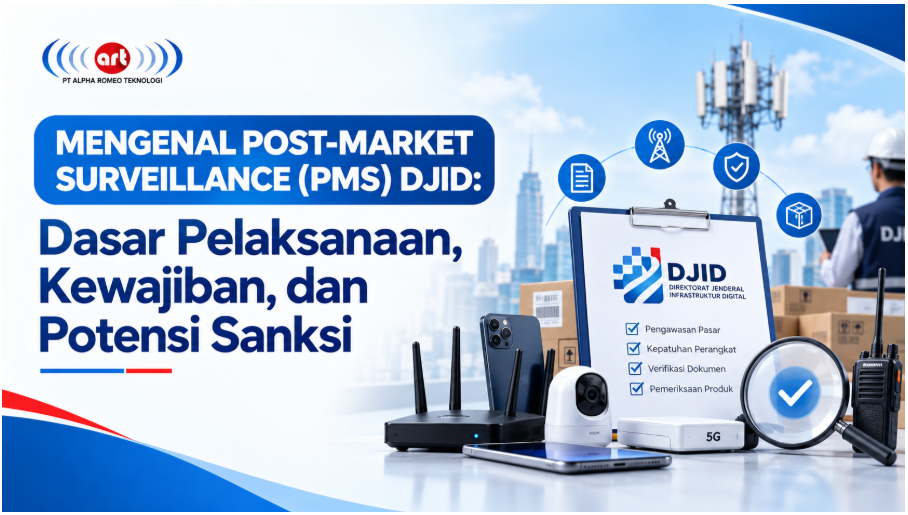
Obtaining a Telecommunication Equipment and/or Telecommunication Device Certificate does not mean that a company’s compliance obligations end once the certificate is issued.
Certified devices that are already distributed in Indonesia may still be subject to supervision to ensure that they remain compliant with the Technical Standards referenced in their certificates.
One of the mechanisms used for this purpose is Post-Market Surveillance (PMS).
Post-Market Surveillance is particularly important for certificate holders, manufacturers, importers, distributors, and other parties involved in distributing telecommunication devices because non-compliance after a product enters the market may lead to administrative consequences.
What Is DJID Post-Market Surveillance?
Post-Market Surveillance (PMS) is a mechanism for checking the conformity of Telecommunication Equipment and/or Telecommunication Devices that have been manufactured, assembled, or imported into Indonesia for sale and/or use.
Through PMS, devices that are already available on the market may be inspected to confirm whether their technical specifications remain compliant with the Technical Standards referenced in the Certificate.
Therefore, PMS is different from testing conducted before a certificate is issued.
During the certification process, a device is tested as part of the requirements for obtaining certification. In contrast, during PMS, devices that are already circulating in the market may be selected as samples and tested again to verify continued compliance.
What Is the Legal Basis for Post-Market Surveillance?
Post-Market Surveillance is regulated under Minister of Communication and Informatics Regulation No. 3 of 2024 concerning Certification of Telecommunication Equipment and/or Telecommunication Devices.
The specific provisions on PMS are mainly set out in Articles 39 to 42.
In addition, Article 34 provides that supervision of Telecommunication Equipment and/or Telecommunication Devices may include:
- Certificate inspection;
- Inspection of Telecommunication Equipment and/or Telecommunication Device labels; and
- Inspection of device conformity with the Technical Standards referenced in the Certificate.
The third type of inspection is carried out through Post-Market Surveillance.
Therefore, PMS specifically focuses on verifying the technical conformity of devices already distributed in the market against the standards used as the basis for certification.
What Factors May Trigger Post-Market Surveillance?
Under Article 39 of Ministerial Regulation No. 3 of 2024, Post-Market Surveillance may be carried out based on several considerations.
These may include the following conditions.
1. The Device Causes or Is Suspected of Causing Interference
PMS may be conducted when Telecommunication Equipment and/or Telecommunication Devices have caused or are suspected of causing interference.
The interference may relate to:
- Telecommunication networks;
- Security;
- Safety; and
- Human health.
2. Reports or Complaints
Reports or complaints concerning a particular device may also be considered when determining whether PMS should be conducted.
Therefore, supervision does not rely only on government monitoring. Information or complaints relating to devices already on the market may also lead to further examination.
3. History of Non-Compliance
A previous history of non-compliance with applicable Technical Standards may also be taken into consideration.
This means that a device’s compliance history may become one of the factors used in determining PMS priorities.
PMS May Be Conducted Routinely or Incidentally
Ministerial Regulation No. 3 of 2024 provides for two types of Post-Market Surveillance.
Routine PMS
Routine Post-Market Surveillance is conducted at least once a year for brands and types of Telecommunication Equipment and/or Telecommunication Devices selected as surveillance objects.
This shows that post-market supervision is not limited to situations where a complaint or technical problem has already occurred.
Incidental PMS
Post-Market Surveillance may also be conducted incidentally.
Incidental PMS may be carried out specifically based on:
- Reports or complaints; and/or
- Other relevant considerations.
Therefore, a device may become subject to inspection outside the routine supervision program when specific circumstances require further examination.
How Is Post-Market Surveillance Conducted?
PMS is not limited to document verification.
Ministerial Regulation No. 3 of 2024 provides a mechanism for testing samples of products already circulating in the market.
In general, the process may include the following steps.
1. Technical Specification Conformity Check
Devices still available in the market may be checked against the Technical Standards referenced in the Certificate.
The purpose is to determine whether the actual products being sold still have technical characteristics that are consistent with their certification basis.
2. Sample Testing
Technical conformity is assessed through Sample Testing conducted by a domestic testing laboratory.
The test results are then used to evaluate whether the product complies with the applicable Technical Standards.
3. Random Sample Selection
Samples used for Post-Market Surveillance are selected randomly.
In practice, devices that are still available on the market may be used as samples to evaluate their conformity with the Technical Standards referenced in their Certificates.
This approach allows the authorities to test products that are actually being sold or used by consumers.
4. Provision of Samples
In principle, the samples required for PMS are provided by the Directorate General.
However, if the Directorate General is unable to provide a sample, the Certificate Holder must provide the required sample in accordance with the applicable provisions.
This requirement should be taken into account by Certificate Holders when their products become subject to Post-Market Surveillance.
5. Evaluation of Test Results
After receiving the test report, the Director General evaluates the Sample Testing results.
The evaluation must be completed within a maximum of 15 Days after the test report is received.
The evaluation determines whether the device complies with the Technical Standards referenced in the Certificate.
What Happens If the Sample Does Not Meet the Technical Standards?
If the evaluation shows that the device does not comply with the Technical Standards referenced in the Certificate, the Director General issues a notification of Technical Standard non-compliance to the Certificate Holder.
However, the process does not necessarily end with the first testing result.
The Certificate Holder has the right to submit an objection.
Can the Certificate Holder Submit an Objection?
Yes.
The Certificate Holder may submit an objection to the Director General regarding the PMS evaluation result.
The objection must be submitted no later than 21 Days from the date of the non-compliance notification.
Several important conditions apply:
- An objection may only be submitted once;
- No fee is charged for submitting the objection;
- The objection must include a request for an appeal test using another sample with the same Certificate number;
- The alternative sample is selected jointly by the Certificate Holder and the Directorate General; and
- The cost of testing the alternative sample and providing the sample is borne by the Certificate Holder.
Based on the appeal test results, the Director General may accept or reject the objection.
A decision on the objection must be issued within a maximum of 15 Days after the Directorate General receives the appeal test result.
If the objection is rejected, the rejection notice may also be accompanied by administrative sanctions in accordance with the applicable provisions.
What Must Be Maintained After Certification?
Certificate Holders need to make sure that products manufactured, imported, and distributed remain consistent with the devices used as the basis for certification.
Several aspects should be monitored, including:
- Brand and device type;
- Technical specifications;
- Hardware or device configuration;
- Radio characteristics;
- RF parameters;
- EMC parameters;
- Safety or other technical parameters, where applicable;
- Compliance with the Technical Standards referenced in the Certificate.
Changes to product design or certain components may affect the device’s technical characteristics.
Therefore, companies should perform a regulatory and technical review before implementing changes involving hardware, RF modules, antennas, power configurations, firmware affecting radio parameters, or other components that may change the device’s technical performance.
What About Certification Labels?
In addition to technical inspections through PMS, Certificate Holders also have obligations relating to device labels.
Ministerial Regulation No. 3 of 2024 requires certified devices to display information including:
- Certificate number and PLG ID;
- QR Code; and
- Warning sign.
The warning sign contains information prohibiting changes to specifications that may cause physical and/or electromagnetic interference with the surrounding environment.
In principle, the label must be placed on the device and its packaging or wrapper.
If the device is too small to accommodate the label, the label may be placed on the packaging or wrapper instead.
In addition, the Certificate Holder must submit evidence of label creation through the Certification Service Facility no later than 30 Days after the Certificate is issued.
It is important to note that label inspection is a separate supervisory mechanism under Ministerial Regulation No. 3 of 2024 and is not the same as technical Sample Testing conducted through PMS.
What Sanctions May Apply If a Product Fails PMS?
The applicable sanctions depend on the party responsible for the violation.
Sanctions for Certificate Holders
If a Certificate Holder manufactures, assembles, and/or imports devices that are found to be non-compliant with the Technical Standards referenced in the Certificate, Ministerial Regulation No. 3 of 2024 provides for sanctions that may include:
- Administrative fines;
- Revocation of the Certificate; and
- Recall of all devices that have been sold and/or used by the public.
For this type of violation, the administrative fine, Certificate revocation, and product recall may be imposed cumulatively and simultaneously in accordance with Article 46.
Furthermore, if the Certificate Holder fails to conduct the required product recall within the specified period, the company may be subject to a suspension of Certificate services for one year.
Therefore, a confirmed PMS non-compliance finding may directly affect both the Certificate and products already distributed in the market.
Sanctions for Parties Selling or Using Non-Compliant Devices
Different provisions apply to parties that sell and/or use devices that:
- Do not have a Certificate; or
- Have a Certificate but do not comply with the Technical Standards referenced in that Certificate.
Administrative sanctions in these circumstances may include:
- Written warning;
- Administrative fine;
- Enforcement measures involving seizure of the devices; and/or
- Recall of devices that have been sold and/or used by the public.
Therefore, it is important to distinguish between sanctions imposed on a Certificate Holder following a PMS technical non-compliance finding and sanctions imposed on parties that sell or use devices that do not meet the regulatory requirements.
Does Certification Exempt a Product from PMS?
No.
A Certificate confirms that a device met the applicable requirements during the certification process.
However, the government may still supervise products after they enter the market.
PMS is necessary because differences may arise between:
- The sample tested during certification; and
- Products later manufactured or distributed on a larger scale.
Changes involving component suppliers, RF modules, antennas, PCBs, certain firmware versions, power configurations, or other technical components may also affect testing results.
For this reason, companies need to maintain product consistency after certification.
What Should Certificate Holders Do?
To reduce the risk of non-compliance during PMS, companies should establish internal controls for product changes.
Several practical steps may help.
1. Maintain Certification Documents and Test Reports
Companies should properly retain documents such as:
- Certification documents;
- Technical specifications;
- Test reports;
- Device photographs;
- Hardware versions;
- Firmware versions; and
- Testing configurations.
These documents can serve as a reference for confirming that mass-produced units remain consistent with the certified device.
2. Implement Change Control
Any change to product components or design should go through an internal evaluation process.
Changes that deserve particular attention include:
- RF modules;
- Chipsets;
- Antennas;
- PCBs;
- Power supplies;
- Radio output configurations;
- Firmware affecting radio functions;
- Enclosures that may affect RF or EMC characteristics.
3. Compare Production Units with the Certified Device
Before distributing products in large quantities, companies may compare production units with the device used as the certification reference.
This helps confirm that the technical specifications remain consistent.
4. Ensure Label Compliance
The Certificate number, PLG ID, QR Code, and required warning sign should be displayed in accordance with the applicable requirements.
5. Prepare for a PMS Request
If a product becomes subject to PMS, the company should prepare the relevant technical documentation and coordinate with the principal or manufacturer.
If the Directorate General cannot provide the necessary sample, the Certificate Holder should also be prepared to provide one as required by the regulation.
Why Is Post-Market Surveillance Important for Importers and Manufacturers?
PMS demonstrates that telecommunication device certification is not merely a process for obtaining a document before a product enters the market.
Technical compliance must continue to be maintained while the product is manufactured, imported, sold, or used in Indonesia.
For manufacturers and importers, this means that product change control is particularly important.
A company that changes components or device configurations without conducting a regulatory review may face the risk that the products distributed in the market no longer comply with the Technical Standards referenced in the Certificate.
To maintain compliance after certification, Certificate Holders, manufacturers, and importers should ensure that product specifications remain consistent with the certified device and carefully control any technical changes that may affect regulatory compliance.
This is especially important because Post-Market Surveillance may be conducted after products have entered the Indonesian market, and any confirmed non-compliance can lead to administrative consequences, including Certificate revocation and product recall.
For this reason, companies should treat post-certification compliance as an ongoing responsibility rather than a one-time certification requirement.
The regulatory basis for these obligations is set out in the following regulation.
Regulatory Reference
Minister of Communication and Informatics Regulation No. 3 of 2024 concerning Certification of Telecommunication Equipment and/or Telecommunication Devices, particularly the provisions on supervision in Articles 34 to 43 and administrative sanctions in Article 44 and subsequent provisions.