
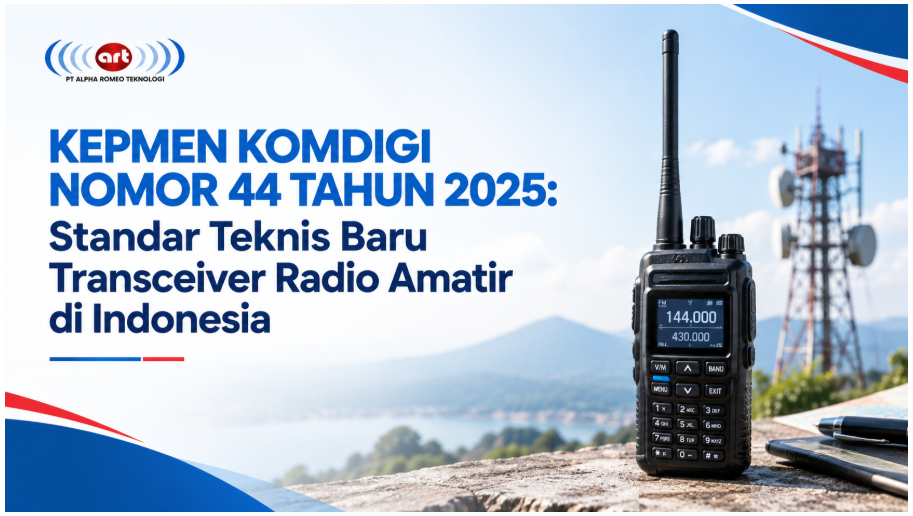
The Indonesian Ministry of Communication and Digital Affairs (KOMDIGI) officially issued KOMDIGI Decree No. 44 of 2025 concerning Technical Standards for Amateur Radio Transceivers.
The government issued the regulation on February 18, 2025, and it became effective six months later, on August 18, 2025.
KOMDIGI Decree No. 44 of 2025 provides the latest technical standards for amateur radio transceivers manufactured, assembled, imported for trading purposes, and/or used in Indonesia.
The regulation covers several important technical areas, including power supply requirements, electrical safety, Electromagnetic Compatibility (EMC), and radio frequency requirements.
Compliance with these technical standards must be demonstrated through a Telecommunication Equipment and/or Telecommunication Device Certificate according to the applicable regulations.
1. What Is an Amateur Radio Transceiver?
Under KOMDIGI Decree No. 44 of 2025, an amateur radio transceiver is telecommunication equipment that can transmit and receive radio waves for amateur radio activities.
In simple terms, a transceiver combines both transmitting and receiving functions in one device.
An amateur radio transceiver generally consists of three main parts:
- Transmitter
This part transmits radio signals or radio waves. - Receiver
This part receives radio signals from other amateur radio stations. - Radio Frequency Tuning System
This part allows the user to select or adjust the operating radio frequency.
Amateur radio activities are not limited to communication as a hobby. They may also support radio technology development, communication between amateur radio stations, communication exercises, and certain emergency or disaster-response activities.
2. Why Are the New Technical Standards Important?
Amateur radio transceivers operate across various radio frequency bands and may use different transmission power levels.
Because they use radio frequency spectrum, devices that do not meet the required technical limits may generate unwanted emissions or interfere with other radio communication systems.
Therefore, KOMDIGI Decree No. 44 of 2025 sets clear technical parameters for amateur radio transceivers.
The regulation covers:
- Power supply requirements
- Electrical safety
- Electromagnetic Compatibility (EMC)
- Radio frequency bands
- Transmitter output power
- Spurious emissions
- Testing methods
With clear technical requirements, laboratories and regulators can evaluate devices using consistent parameters before companies trade or use them in Indonesia.
3. What Technical Requirements Does the Regulation Cover?
KOMDIGI Decree No. 44 of 2025 covers four main groups of technical requirements.
A. Power Supply Requirements
For amateur radio transceivers that use AC power, all technical parameters must comply when the equipment operates at:
AC 220 V ± 10% with a frequency of 50 Hz ± 2%.
If the device uses an external power supply, such as an AC/DC converter or adapter, the external power supply must not affect the device’s ability to meet the required technical parameters.
Therefore, the power supply system forms an important part of device testing and technical evaluation.
B. Electrical Safety Requirements
Amateur radio transceivers must also meet applicable electrical safety requirements.
The standards may include:
- SNI IEC 60950-1:2016
- IEC 60950-1
- SNI IEC 62368-1:2014
- IEC 62368-1
Electrical safety evaluation may cover parameters such as:
- Overvoltage, electric strength, or dielectric strength
- Leakage current or touch current
For testing based on IEC 62368-1, the assessment may also include identification of energy sources, classification of potential hazards, and evaluation of safeguards against those energy sources.
As a result, manufacturers and applicants need to determine which electrical safety standard applies to the device before testing.
C. Electromagnetic Compatibility (EMC) Requirements
For EMC requirements, the regulation classifies amateur radio transceivers into three equipment categories.
- Fixed Equipment
Equipment installed in a fixed location or operated using AC power. - Vehicular Equipment
Equipment designed for use in vehicles and powered mainly by the vehicle battery. - Portable Equipment
Portable equipment that uses a battery as its primary power source.
However, if vehicular or portable equipment can also operate using an AC power supply, the regulation classifies the equipment as fixed equipment for EMC requirement purposes.
For EMC emissions, devices must comply with one of the applicable standards, including:
- SNI CISPR 32:2015 or its latest version
- IEC CISPR 32
- ETSI EN 301 489-1 and ETSI EN 301 489-15
Emission testing may include:
- Radiated emissions from the enclosure port
- Conducted emissions from DC power ports
- Conducted emissions from AC power ports
- Conducted emissions from wired network ports
Meanwhile, requirements for EMC immunity are regulated under a separate Ministerial Decree.
Therefore, KOMDIGI Decree No. 44 of 2025 specifically addresses the applicable EMC emission requirements, while immunity requirements follow separate regulations.
4. Radio Frequency Requirements
Radio frequency requirements form one of the most important parts of the technical standard for amateur radio transceivers.
Each device must comply with requirements related to:
- Radio frequency bands
- Operating frequency range
- Conducted output power
- Transmitter spurious emissions
The regulation covers amateur radio frequency bands from:
- LF (Low Frequency)
- MF (Medium Frequency)
- HF (High Frequency)
- VHF (Very High Frequency)
- UHF (Ultra High Frequency)
- SHF (Super High Frequency)
Output power limits vary depending on the frequency band and, for certain bands, the type of equipment, such as handheld, mobile, or base/repeater equipment.
For example, in the VHF 144–148 MHz band, the conducted output power limits are:
- Handheld: ≤10 W
- Mobile: ≤100 W
- Base/Repeater: ≤100 W
Meanwhile, in the UHF 430–440 MHz band, the limits are:
- Handheld: ≤10 W
- Mobile: ≤100 W
- Base/Repeater: ≤100 W
In addition to output power, devices must also meet the applicable spurious emission limits.
For equipment operating at frequencies up to 30 MHz, the regulation determines spurious emission attenuation based on output power or 50 dBc according to the specified formula.
For equipment operating above 30 MHz, the applicable limit is determined based on output power or 70 dBc according to the regulation.
5. How Is the Device Tested?
KOMDIGI Decree No. 44 of 2025 does not only define technical parameters. It also provides testing methods for evaluating compliance.
Electrical Safety Testing
For electrical safety, the testing method may refer to:
- SNI IEC 60950-1:2016 or its latest version
- SNI IEC 62368-1:2014 or its latest version
- IEC 60950-1
- IEC 62368-1
The applicable method depends on the device and the safety standard used for evaluation.
EMC Testing
For EMC emission testing, laboratories may use:
- SNI CISPR 32:2015 or its latest version
- IEC CISPR 32
- ETSI EN 301 489-1
- ETSI EN 301 489-15
- Other testing methods determined by the Director General responsible for telecommunication equipment and device standardization
Accordingly, companies should make sure that the selected test method matches the applicable technical requirements before testing begins.
Radio Frequency Testing
Radio frequency testing is carried out under normal environmental conditions or according to the relevant testing method.
In addition, testing must follow the technical specifications of the amateur radio transceiver submitted for certification.
Therefore, the device specification, test configuration, and technical documentation should accurately represent the product that the company plans to certify.
6. Exemptions from the Technical Standards
KOMDIGI Decree No. 44 of 2025 provides exemptions from the technical standard requirements for amateur radio transceivers used for certain purposes.
The exemptions apply to devices used for:
- Research and Development (R&D)
- Disaster response
- Technology trials
However, an important condition applies.
Devices used under these exemptions must not be commercialized or traded.
Therefore, companies cannot automatically use these exemptions for products that they intend to sell or distribute commercially in Indonesia.
7. What Happens to Test Reports Issued Before the Regulation Took Effect?
KOMDIGI Decree No. 44 of 2025 also provides transitional provisions for existing test reports.
A test report for an amateur radio transceiver issued before the regulation became effective may still be submitted as part of a certification application.
However, the test report can only be used if:
- It does not conflict with KOMDIGI Decree No. 44 of 2025
- It does not conflict with other applicable laws and regulations
Therefore, companies that already have an existing test report do not automatically need to repeat all testing.
Nevertheless, companies should review the test report first to confirm that its parameters, test standards, frequency information, output power, and other technical data still meet the latest requirements.
8. Device Certification Is Different from an Amateur Radio License
Companies and users should also understand the difference between device certification and permission to operate an amateur radio station.
Compliance with KOMDIGI Decree No. 44 of 2025 is demonstrated through a Telecommunication Equipment and/or Telecommunication Device Certificate.
However, obtaining a device certificate does not automatically give an individual permission to operate an amateur radio station.
Indonesia also has separate rules for the Amateur Radio License (Izin Amatir Radio/IAR).
An IAR allows an individual to establish, own, and operate an amateur radio station according to the applicable requirements.
Therefore, companies and users should distinguish between:
- Device certification, which relates to compliance with technical standards; and
- Amateur radio operating authorization, which relates to the right to operate an amateur radio station.
Need Help with Amateur Radio Transceiver Certification?
PT. Alpha Romeo Teknologi Is Ready to Assist Your Certification Process
If your company plans to import or market amateur radio transceivers in Indonesia, identifying the applicable technical standards before testing can help reduce the risk of incorrect testing or documentation.
PT. Alpha Romeo Teknologi provides assistance for:
- DJID/SDPPI certification requirement analysis
- KOMDIGI Decree No. 44 of 2025 regulatory analysis
- Telecommunication equipment and device certification
- Technical specification review
- Test report evaluation and review
- RF Testing
- EMC Testing
- Electrical Safety Testing
- Telecommunication device re-certification
- Indonesian telecommunication regulatory consultation
Our team can also help companies identify the applicable technical requirements and supporting documents before the certification process begins.
With proper regulatory analysis, testing preparation, and document review from the beginning, companies can manage the certification process in a more structured and compliant manner.