
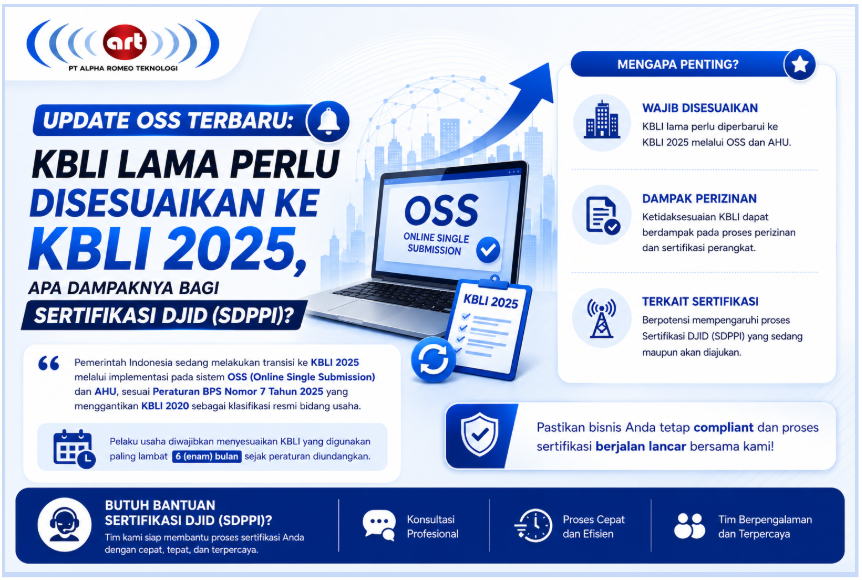
The Indonesian government has implemented KBLI 2025 (Klasifikasi Baku Lapangan Usaha Indonesia) as the latest classification system for business activities in Indonesia.
The government introduced KBLI 2025 through BPS Regulation No. 7 of 2025 concerning the Indonesian Standard Industrial Classification. Later, the government updated several provisions through BPS Regulation No. 6 of 2026.
KBLI 2025 has also been integrated into the Online Single Submission (OSS) system and the Directorate General of General Legal Administration (AHU) system.
For companies operating in telecommunications, electronics, information technology, device manufacturing, or the import of telecommunication equipment and devices, this change requires attention.
The reason is simple. Companies need accurate and up-to-date business data in OSS when applying for DJID Telecommunication Equipment and/or Device Certification, which many companies still know as SDPPI or Postel Certification.
So, does every company need to change its old KBLI to KBLI 2025? More importantly, can this change affect the DJID certification process?
Here is the explanation.
What Is KBLI?
KBLI, or Klasifikasi Baku Lapangan Usaha Indonesia, is Indonesia’s official classification system for economic and business activities.
In simple terms, KBLI describes the type of business activity a company carries out.
Companies use KBLI codes in many administrative and licensing processes, including:
- Business Identification Number (NIB) registration
- Risk-Based Business Licensing through OSS
- Business Licensing to Support Business Activities or PB UMKU
- Business activity reporting
- Sector-specific licensing
- Government procurement and tenders
- Registration and licensing with ministries or government agencies
Therefore, companies need to make sure that the business activities listed in OSS match their actual operations.
However, it is important to understand that KBLI itself is not the company’s business identity.
The Business Identification Number (NIB) acts as the business identity. Meanwhile, KBLI classifies the business activities listed under the company’s licensing data.
What Changed from KBLI 2020 to KBLI 2025?
KBLI 2025 replaces KBLI 2020 as Indonesia’s latest classification system for economic activities.
The changes do not only involve new code numbers. Depending on the business sector, the update may also include:
- Changes to business activity names
- Updates to KBLI descriptions
- Merging several business activities into one classification
- Splitting one business activity into several new classifications
- Changes to the scope of business activities
- New classifications for emerging economic activities
As a result, a KBLI code that a company used under KBLI 2020 may have a different number under KBLI 2025.
However, this does not mean that every company must immediately amend its Articles of Association or reapply for all business licenses.
Does Every Company Need to Update Its KBLI Manually?
Not always.
The government provides different adjustment methods depending on the type of change.
If the transition from the old KBLI to KBLI 2025 only changes the numerical code without changing the actual business activity, the OSS and AHU systems may automatically convert the code.
Therefore, a company does not necessarily need to amend its Articles of Association only because its KBLI number changes while the business activity remains the same.
In addition, existing Business Licenses, Basic Requirements, and PB UMKU issued before the implementation of KBLI 2025 generally remain valid.
However, the situation may be different when the change affects:
- The company’s objectives
- The company’s purposes
- The scope of business activities
- The type of business activity
- Business activities stated in the Articles of Association
In such cases, the company may need to update its corporate information through AHU. If necessary, the company may also need to amend its Articles of Association through a notary.
After completing the amendment, the company should make sure that the latest information is synchronized with OSS.
How Does KBLI 2025 Relate to DJID (SDPPI) Certification?
Companies that want to apply for a Telecommunication Equipment and/or Device Certificate need to start the process through OSS.
Under Indonesia’s telecommunications business licensing system, business entities apply for certification through the PB UMKU menu in OSS.
In general, the process includes the following steps:
- Log in to the OSS system.
- Select the company’s KBLI.
- Select the PB UMKU for Telecommunication Equipment and/or Device Certification.
- Obtain a Permit ID (ID Izin PB UMKU) from OSS.
- Use the Permit ID to continue the application through the DJID Certification Service.
- Complete the application form and submit the required certification documents.
Therefore, accurate company information in OSS remains important for the certification process.
Does DJID Certification Require a Specific Telecommunication KBLI?
No.
This point is important because many companies misunderstand the requirement.
Under Minister of Communication and Digital Affairs Regulation No. 15 of 2025, the PB UMKU for Telecommunication Equipment and/or Device Certification is available for all KBLI codes.
In other words, a company does not need to have one specific telecommunication KBLI only to apply for device certification.
For example, trading companies, manufacturers, distributors, and companies operating under other business classifications may still apply for certification as long as they meet the applicable requirements for certification applicants.
Therefore, the main issue is not whether the company has a specific “telecommunication KBLI.”
Instead, the company should make sure that:
- Its OSS data is accurate and up to date.
- Its NIB is active and matches its business activities.
- Its KBLI follows the applicable classification.
- The company can process the required PB UMKU through OSS.
- OSS can issue the required Permit ID.
- The applicant documents meet DJID certification requirements.
Can an Old KBLI Cause Problems with DJID Certification?
Using an old or outdated KBLI does not automatically mean that DJID will reject a certification application.
However, outdated or unsynchronized company data may create administrative problems when the company uses OSS services.
For example, a company may face difficulties if the business activity information in OSS does not match the corporate data registered in AHU.
In addition, inconsistent information may affect the company’s ability to create or use the required PB UMKU for certification.
Therefore, companies that plan to apply for DJID certification should check their business data as early as possible.
This step is especially important for companies that previously used KBLI 2020 or have corporate information that has not yet been updated.
When Does a Company Need to Amend Its Articles of Association?
A change in KBLI does not automatically require a company to amend its Articles of Association.
If the change only involves the conversion of a KBLI number and does not change the actual business activity, the system may handle the adjustment through synchronization.
However, an amendment may become necessary when the KBLI adjustment also changes:
- The company’s objectives
- The company’s purposes
- The company’s business activities
- The scope of activities stated in the Articles of Association
In this situation, the company may need to process an amendment through a notary and AHU first.
After that, the company should update or synchronize the new information with OSS.
Because this process may take time, companies should not wait until the certification application is about to start.
What Should Companies Check Before Applying for DJID Certification?
Before applying for telecommunication equipment or device certification, companies should perform several initial checks.
1. Check the NIB in OSS
Make sure the company’s NIB is active and that the business information reflects the company’s current condition.
2. Check the Company’s KBLI
Make sure the KBLI code and description match KBLI 2025 and the company’s actual business activities.
If the system has automatically converted the KBLI, the company should still check whether the conversion result is correct.
3. Check the Company Data in AHU
For legal entities, make sure that the information registered in AHU matches the information in OSS.
If the company has changed its business activities, it may need to amend its Articles of Association first.
4. Make Sure the PB UMKU Is Available
The company should confirm that it can access and process the PB UMKU for Telecommunication Equipment and/or Device Certification through OSS.
5. Make Sure OSS Issues the Permit ID
The Permit ID or ID Izin PB UMKU is part of the certification process and allows the company to continue the application through the DJID Certification Service.
6. Prepare the Certification Documents
In addition to OSS and KBLI requirements, companies also need to prepare the technical and administrative documents required for the type of device they want to certify.
Depending on the product, these documents may include:
- Test reports
- Technical specifications
- Applicant documents
- Trademark documents
- Supporting technical documents
- Other documents required under the applicable certification rules
Why Should Companies Check Their KBLI Early?
Some companies only check their OSS information when they are ready to apply for a license or certification.
However, this approach may cause delays if the company discovers that some information needs to be corrected.
For example, if a company needs to change the business activities in its Articles of Association, the process may involve:
- A notary
- The AHU system
- Company data synchronization
- Updates in OSS
- Another review of PB UMKU availability
Therefore, companies should check their licensing data before setting a certification schedule.
Early preparation gives the company enough time to solve administrative issues without affecting the planned product launch or market entry.
What Is the Impact on Telecommunication Companies and Importers?
For companies involved in importing, distributing, manufacturing, or trading telecommunication equipment and devices, accurate licensing data can affect business operations.
Possible impacts may include:
- Delays in creating PB UMKU
- Problems obtaining or using a Permit ID
- Differences between OSS and AHU data
- The need to amend the Articles of Association when business activities change
- Delays in device certification applications
- Delays in product distribution or market launch
However, the actual impact depends on the condition of each company’s data.
Therefore, companies should not immediately change their corporate documents without first checking the KBLI conversion results and their current information in OSS.
The implementation of KBLI 2025 changes the business activity classification used in Indonesia’s licensing system.
However, not every company needs to update its KBLI manually or amend its Articles of Association.
If the change only involves a numerical KBLI conversion without changing the actual business activity, OSS and AHU may handle the adjustment automatically.
On the other hand, if the change affects the company’s objectives, purposes, or business activities, the company may need to update its corporate documents through a notary and AHU.
For DJID (SDPPI) Certification, companies should also make sure that their NIB and KBLI information in OSS is accurate because business applicants begin the certification process through PB UMKU and continue it using the Permit ID issued by OSS.
It is also important to understand that the PB UMKU for Telecommunication Equipment and/or Device Certification is available for all KBLI codes. Therefore, a company does not need one specific telecommunication KBLI only to apply for device certification.
The most important step is to make sure that the company’s business data, NIB, KBLI, and supporting documents are accurate before starting the certification process.
By checking everything early, companies can reduce the risk of administrative problems that may affect their certification schedule and product market entry in Indonesia.
Need Help with DJID (SDPPI) Certification?
PT. Alpha Romeo Teknologi Is Ready to Assist Your Certification Process
If your company needs assistance with:
- DJID/SDPPI/Postel Certification
- SAR regulatory analysis
- Document and test report review
- Certification document evaluation
- Re-certification of mobile devices and tablets
- RF & EMC Testing
PT. Alpha Romeo Teknologi is ready to assist your company with telecommunication equipment and device certification in Indonesia.
Our team can also help perform an initial review of the administrative and certification requirements before the application process begins.
With proper document preparation and early identification of the applicable requirements, companies can manage the certification process more efficiently and reduce unnecessary delays.
Regulatory References
- BPS Regulation No. 7 of 2025 concerning the Indonesian Standard Industrial Classification (KBLI).
- BPS Regulation No. 6 of 2026 concerning the Amendment to BPS Regulation No. 7 of 2025.
- Joint Circular of the Minister of Investment and Downstream Industry/Head of BKPM, Minister of Law, and Head of the Central Statistics Agency concerning the implementation of KBLI 2025 adjustments.
- Minister of Communication and Digital Affairs Regulation No. 15 of 2025 concerning Business Activity Standards and Product/Service Standards under Risk-Based Business Licensing for the Postal, Telecommunications, Broadcasting, and Electronic Systems and Transactions sectors.
#KBLI 2025 #DJID #SDPPI #DJID Certification #SDPPI Certification #OSS #NIB #PB UMKU #Telecommunication Device Certification #Komdigi