

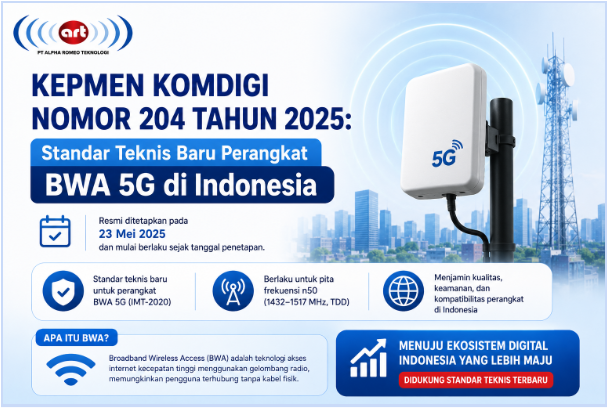
Kepmen Komdigi No. 204 of 2025: Technical Standards for IMT-2020-Based BWA 5G Devices
The Ministry of Communication and Digital Affairs of the Republic of Indonesia officially issued Ministerial Decree No. 204 of 2025 concerning the Technical Standards for Telecommunication Equipment and/or Telecommunication Devices for Broadband Wireless Access Based on International Mobile Telecommunications-2020 (IMT-2020) Technology Standards.
The Ministry enacted this regulation on May 23, 2025, and made it effective on the same date. Kepmen Komdigi No. 204 of 2025 now serves as the latest technical reference for Broadband Wireless Access (BWA) devices based on 5G IMT-2020 technology that businesses plan to market, use, or certify in Indonesia.
This regulation covers two main device categories: 5G BWA Subscriber Stations and 5G BWA Base Stations. Manufacturers, importers, distributors, brand owners, and telecommunication businesses need to understand these technical requirements before submitting devices for certification.
What Is Broadband Wireless Access (BWA)?
Broadband Wireless Access, or BWA, refers to broadband internet access technology that uses wireless networks as the transmission medium. This technology allows service providers to deliver internet access without relying entirely on physical cable networks such as fiber optics or DSL.
In simple terms, BWA allows operators or service providers to distribute internet connectivity to users through radio signals.
Common examples of BWA implementation include:
- wireless-based home internet,
- Fixed Wireless Access (FWA),
- indoor and outdoor operator modems,
- internet access in areas without fiber-optic coverage,
- broadband networks for industrial use,
- and 5G-based broadband services.
In the latest technology ecosystem, IMT-2020-based BWA supports 5G implementation, especially for high-speed wireless broadband access services.
Why Is BWA Important in Indonesia?
Indonesia has a vast territory and diverse geographical conditions. These challenges make wired network deployment difficult in some areas, especially rural regions, certain industrial zones, and locations that need fast connectivity without complex cable infrastructure.
BWA can help Indonesia:
- Accelerate equal access to internet services.
- Reduce dependence on cable infrastructure.
- Support national digital transformation.
- Expand broadband service coverage.
- Support 5G and Fixed Wireless Access implementation.
- Meet connectivity needs in industrial and business sectors.
For this reason, the government established technical standards to ensure that BWA devices distributed and used in Indonesia meet safety, compatibility, quality, and radio frequency spectrum efficiency requirements.
Purpose of Kepmen Komdigi No. 204 of 2025
Kepmen Komdigi No. 204 of 2025 provides a technical reference for BWA devices that use IMT-2020 technology standards.
In general, this regulation aims to:
- Ensure that 5G BWA devices comply with applicable technical standards.
- Support efficient use of radio frequency spectrum.
- Maintain device compatibility with Indonesia’s national telecommunication networks.
- Minimize the potential for harmful interference.
- Ensure compliance with electrical safety requirements.
- Ensure compliance with electromagnetic compatibility (EMC) requirements.
- Support the telecommunication device certification process in Indonesia.
For businesses, this regulation plays an important role because it serves as one of the references for the DJID/SDPPI/Postel certification process for 5G BWA devices.
What Devices Does This Regulation Cover?
Kepmen Komdigi No. 204 of 2025 specifically covers two categories of IMT-2020-based BWA devices.
1. 5G BWA Subscriber Station
A Subscriber Station, or 5G BWA SS, refers to a device located on the user side. It functions as customer terminal equipment that receives and transmits broadband connectivity through a 5G BWA network.
Devices that may fall under this category include:
- 5G BWA customer devices,
- 5G modems or access terminals,
- Fixed Wireless Access devices,
- customer premises equipment (CPE),
- and other broadband access devices that operate under IMT-2020 standards.
2. 5G BWA Base Station
A Base Station, or 5G BWA BS, refers to a network device that provides broadband access services to subscriber devices. Operators or telecommunication network providers typically use this type of device.
The Base Station plays an important role in BWA services because it acts as the transmission and reception point between the operator’s network and subscriber devices.
Use of IMT-2020 Technology
This regulation adopts International Mobile Telecommunications-2020, or IMT-2020, as the applicable technology standard. IMT-2020 serves as the international technology framework for 5G networks.
By applying IMT-2020 standards, Indonesia requires BWA devices to meet technical specifications that align with the modern 5G ecosystem.
This requirement helps ensure that devices operate reliably, remain compatible with national networks, and avoid harmful interference with other telecommunication devices or services.
Use of the n50 Frequency Band
One of the key technical points in Kepmen Komdigi No. 204 of 2025 involves the use of the n50 frequency band.
For 5G BWA Subscriber Stations, the regulation sets the applicable radio frequency range at 1432 MHz to 1517 MHz with TDD, or Time Division Duplex, mode.
For 5G BWA Base Stations, the technical operating requirements specify the use of the 1432 MHz to 1512 MHz radio frequency range.
Manufacturers, importers, vendors, and certification applicants need to pay attention to this distinction to ensure that their device specifications meet the applicable requirements.
Power Supply Requirements for Subscriber Stations
5G BWA Subscriber Stations must use a wired power source. The device may draw power directly from an AC connection or through an AC/DC converter connected to the electrical grid.
The regulation does not allow 5G BWA Subscriber Stations to use batteries as their main power source. Companies should consider this requirement from the product design stage, model selection stage, and certification preparation stage.
In other words, manufacturers must design 5G BWA SS devices as fixed equipment powered through an appropriate electrical source.
Electrical Safety and EMC Requirements
5G BWA devices must meet electrical safety and electromagnetic compatibility (EMC) requirements.
Electrical safety requirements help ensure that devices remain safe for users and the surrounding environment.
EMC requirements help ensure that devices do not generate harmful electromagnetic interference and can operate properly alongside other electronic equipment.
This regulation references several standards, including:
- SNI IEC 62368-1,
- SNI IEC 60950-1,
- IEC 62368-1,
- IEC 60950-1,
- SNI CISPR 32,
- IEC CISPR 32,
- and relevant ETSI EN standards according to the device category.
Radio Frequency Testing Parameters
In addition to electrical safety and EMC, 5G BWA devices must also meet radio frequency testing parameters.
These parameters may include:
- output power,
- minimum output power,
- spectrum emission mask,
- adjacent channel leakage ratio (ACLR),
- transmitter spurious emissions,
- receiver sensitivity,
- receiver spurious emissions,
- blocking characteristics,
- and other radio parameters according to the device category.
These tests help confirm that the device operates according to technical standards and does not interfere with radio frequency spectrum usage.
Related Regulatory Framework
Kepmen Komdigi No. 204 of 2025 forms part of Indonesia’s broader telecommunication regulatory framework, especially regulations related to telecommunication device certification and radio frequency spectrum usage.
Several related regulations include:
- Law No. 36 of 1999 concerning Telecommunications.
- Government Regulation No. 46 of 2021 concerning Postal Services, Telecommunications, and Broadcasting.
- Minister of Communication and Informatics Regulation No. 3 of 2024 concerning Certification of Telecommunication Equipment and/or Devices.
- Minister of Communication and Digital Affairs Regulation No. 13 of 2025 concerning the Use of Radio Frequency Spectrum in the 1.4 GHz Frequency Band.
Businesses should not view Kepmen No. 204 only as a technical device standard. They should also understand it as part of Indonesia’s wider certification and radio frequency spectrum regulatory ecosystem.
Impact on Manufacturers, Importers, and Device Vendors
Kepmen Komdigi No. 204 of 2025 directly affects companies that manufacture, import, distribute, or market 5G BWA devices in Indonesia.
The following parties need to pay close attention to this regulation:
- telecommunication device manufacturers,
- 5G device importers,
- BWA device distributors,
- brand owners,
- network device vendors,
- telecommunication operators,
- CPE device providers,
- and companies applying for telecommunication device certification.
Companies may face certification obstacles if their devices do not comply with the required technical standards. In some cases, non-compliant devices may not enter the Indonesian market legally.
Steps Companies Should Take
To comply with the latest requirements, companies should take the following steps.
1. Review Device Specifications
Companies should confirm whether the device falls under the 5G BWA Subscriber Station or 5G BWA Base Station category. They should also review frequency support, duplex mode, power supply requirements, and other technical parameters.
2. Check Technical Documents
Companies should prepare documents such as datasheets, user manuals, technical specifications, test reports, labels, device photos, and other supporting documents required for the certification process.
3. Evaluate Frequency Compliance
Companies should ensure that the device supports the frequency range required in Indonesia, particularly the n50 band and the operational requirements for the 1.4 GHz frequency band.
4. Ensure EMC and Safety Compliance
Companies should check whether the device meets the applicable EMC and electrical safety requirements.
5. Conduct Testing at the Appropriate Laboratory
Companies should conduct RF, EMC, and electrical safety testing at a suitable laboratory when the certification process requires it.
Need Assistance with 5G BWA Certification?
PT. Alpha Romeo Teknologi can assist your company with the telecommunication device certification process in a professional and comprehensive manner.
We can support your needs related to:
- DJID/SDPPI/Postel certification,
- analysis of BWA 5G and IMT-2020 regulations,
- document and test report review,
- certification document evaluation,
- re-certification of BWA and telecommunication devices,
- RF testing,
- EMC testing,
- and consultation on Indonesian telecommunication regulations.
With the right assistance, your company can manage the 5G BWA device certification process in a more structured, efficient, and compliant way.
Conclusion
Kepmen Komdigi No. 204 of 2025 sets important technical standards for IMT-2020-based Broadband Wireless Access devices in Indonesia.
This regulation covers 5G BWA Subscriber Stations and 5G BWA Base Stations, including requirements related to frequency, power supply, electrical safety, EMC, and radio testing parameters.
For manufacturers, importers, vendors, and certification applicants, understanding these requirements from the beginning can reduce the risk of document non-compliance, accelerate the certification process, and help ensure that devices can enter the Indonesian market legally.
FAQ: Kepmen Komdigi No. 204 of 2025
What is Kepmen Komdigi No. 204 of 2025?
Kepmen Komdigi No. 204 of 2025 sets the technical standards for IMT-2020-based Broadband Wireless Access devices in Indonesia.
What is 5G BWA?
5G BWA refers to a wireless broadband access service based on 5G technology. It supports high-speed internet connectivity without requiring a direct wired network connection to the user.
What devices does this regulation cover?
This regulation covers 5G BWA Subscriber Stations and 5G BWA Base Stations.
What is the n50 frequency band?
The n50 frequency band refers to one of the operating bands for 5G BWA devices. Under this regulation, 5G BWA Subscriber Stations use the 1432 MHz to 1517 MHz range with TDD mode.
Can a 5G BWA Subscriber Station use a battery?
No. A 5G BWA Subscriber Station must use a wired power supply through a direct AC connection or an AC/DC converter. The device cannot use a battery as its main power source.
Do companies need to certify 5G BWA devices?
Yes. Companies must certify 5G BWA devices that they manufacture, assemble, import, trade, or use in Indonesia. These devices must comply with the applicable technical standards and follow the telecommunication device certification process.