

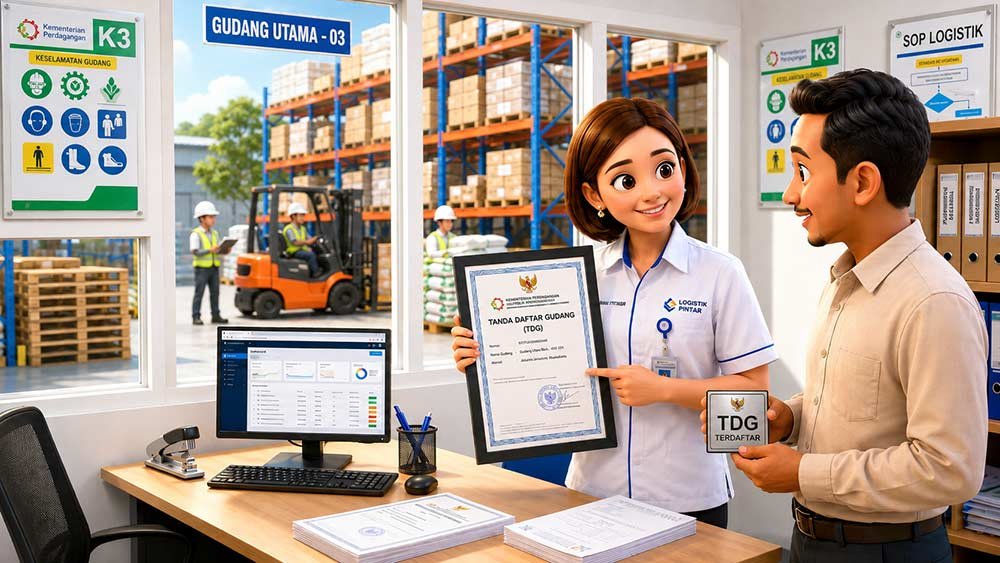
Warehousing facilities play a vital role in Indonesia’s industrial and commercial supply chain. To ensure that warehousing activities operate legally, the Indonesian government requires every warehouse owner or business operator to obtain an official permit known as the Warehouse Registration Certificate (Tanda Daftar Gudang/TDG). This regulation is intended to create a transparent, secure, and well-documented goods distribution system.
Below is a comprehensive overview of the Warehouse Registration Certificate (TDG) in accordance with the applicable regulations in Indonesia.
What Is a Warehouse Registration Certificate (TDG)?
A Warehouse Registration Certificate (Tanda Daftar Gudang/TDG) is an official registration document issued by the relevant government authority to warehouse owners or operators. This certificate serves as legal proof that a fixed storage facility—whether enclosed or open storage space—has been officially registered for the commercial storage of goods intended for trade rather than personal consumption.
The TDG registration includes information such as the warehouse or warehouse location, storage area, storage capacity, and warehouse classification.
Why Is a Warehouse Registration Certificate (TDG) Required?
The obligation to obtain a TDG is based on the government’s role in supervising the national trade and distribution system. By obtaining this certificate, businesses benefit from several key advantages:
- Legal Compliance: Helps companies avoid administrative sanctions, including fines, suspension of operations, or warehouse sealing by the relevant authorities.
- Prevention of Illegal Hoarding: Enables the government to monitor the movement of goods, particularly essential commodities, to prevent market manipulation and illegal stockpiling.
- Business Credibility: Provides assurance to investors, banks, and logistics partners that the company’s supply chain operates through legally registered warehouse facilities.
Functions and Validity of a Warehouse Registration Certificate (TDG)
Under Indonesia’s current business licensing system, a TDG remains valid as long as the company continues operating its business activities at the registered warehouse. Businesses are only required to update their registration if there are significant changes, such as warehouse expansion or changes in the types of goods being stored.
A TDG serves several important purposes, including:
- Supporting customs administration for import activities (both General Importer Identification Number/API-U and Producer Importer Identification Number/API-P), as well as export activities.
- Fulfilling administrative requirements for product distribution permits issued by authorities such as BPOM, SNI certification, Technical Recommendations, and Import Approvals.
- Demonstrating compliance with Indonesia’s national logistics standards during both internal and external audits.
Legal Basis of the Warehouse Registration Certificate (TDG)
The obligation to register a warehouse is stipulated under Article 61 of Government Regulation (PP) No. 29 of 2021 concerning the Administration of the Trade Sector, which requires every warehouse owner to register their warehouse facilities.
The regulation is also aligned with Government Regulation (PP) No. 5 of 2021, which integrates warehouse licensing into Indonesia’s Risk-Based Business Licensing system through Supporting Business Activity Licenses (PB-UMKU).
Requirements for Obtaining a Warehouse Registration Certificate (TDG)
To register a warehouse online, business owners must prepare the following administrative and technical documents:
- Business Identification Number (NIB) with the appropriate Indonesian Standard Industrial Classification (KBLI) for warehousing activities.
- Company legal documents, including the Deed of Establishment, Ministry of Law and Human Rights Approval Letter, and Corporate Tax Identification Number (NPWP).
- Proof of ownership or legal control of the warehouse, such as a Land Ownership Certificate (SHM), Right to Build Certificate (HGB), or a valid warehouse lease agreement.
- Building Approval (PBG) or Building Construction Permit (IMB) showing the building’s designated function as a warehouse.
- Environmental management documents, such as SPPL, UKL-UPL, or an approved Environmental Impact Assessment (AMDAL), where applicable.
- Warehouse layout drawings along with information regarding storage capacity and storage capacity and load capacity.
How to Apply for a Warehouse Registration Certificate (TDG)
The application process is conducted electronically through Indonesia’s Risk-Based Online Single Submission (OSS) system by following these steps:
1. Access the OSS System
Visit the official Risk-Based Online Single Submission (OSS) portal and log in using your company’s registered account.
2. Select PB-UMKU
Navigate to the Operational/Commercial Licensing (PB-UMKU) menu and select Warehouse Registration Certificate (TDG).
3. Complete the Application Form
Provide detailed information regarding the warehouse location, address, floor area, storage capacity, and the types of goods to be stored.
4. Upload the Required Documents
Submit all required supporting documents, including the Building Approval (PBG) or IMB, land ownership or lease documents, and environmental permits.
5. Field Verification
The local Department of Trade reviews the documents and conducts an on-site warehouse inspection.
6. Certificate Issuance
Once approved, the TDG is issued electronically through the OSS system for business licensing and compliance purposes.