

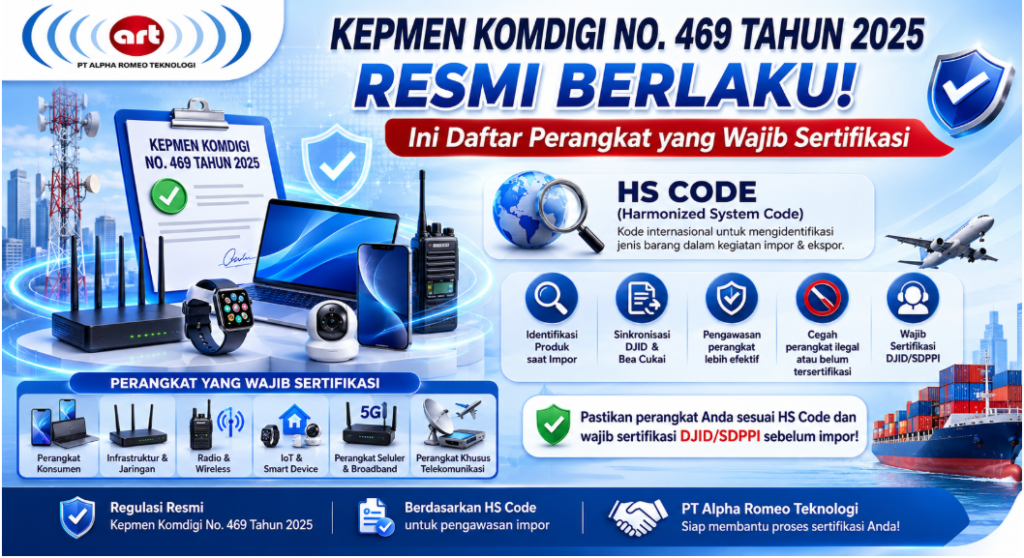
On November 7, 2025, the Ministry of Communication and Digital Affairs of the Republic of Indonesia officially issued Decree of the Minister of Communication and Digital Affairs of the Republic of Indonesia No. 469 of 2025 concerning the List of Telecommunication Equipment and/or Telecommunication Devices Required to Meet Technical Standards.
The regulation was introduced to improve the monitoring and control of telecommunication devices distributed in Indonesia and ensure that these devices comply with applicable technical requirements.
1. What Is an HS Code?
Before discussing Komdigi Decree No. 469 of 2025, it is important to understand what an HS Code is.
An HS Code (Harmonized System Code) is an international product classification system used to identify goods in import and export activities. The system was developed by the World Customs Organization (WCO) and is used by most countries around the world, including Indonesia.
In Indonesia, HS Codes are commonly used by:
- Indonesian Customs
- Government ministries and authorities
- Importers and exporters
- Certification bodies
- National customs systems
Each product has an HS Code based on its category, characteristics, and function.
2. Why Are HS Codes Important Under Komdigi Decree No. 469 of 2025?
Under Komdigi Decree No. 469 of 2025, the list of telecommunication devices required to meet technical standards is organized based on HS Codes.
The use of HS Codes helps to:
- Identify products during the import process
- Synchronize data between DJID and Indonesian Customs
- Reduce product classification errors
- Improve the monitoring of telecommunication devices
- Prevent illegal or uncertified devices from entering Indonesia
By using HS Codes, the government can more easily determine whether a product may be subject to DJID/SDPPI certification requirements.
3. List of Telecommunication Devices Under Komdigi Decree No. 469 of 2025
The regulation covers various categories of telecommunication equipment and devices.
a. Consumer Telecommunication Devices
- Laptops
- Tablets
- Handheld computers
- Cordless telephones
- Smartphones
- Feature phones
- Smartwatches
- Satellite phones
- IP phones
- Video phones and video conference devices
b. Network and Infrastructure Equipment
- Routers
- Modems
- Access points
- Repeaters
- Gateways
- Network switches
- Base Transceiver Stations (BTS)
- Microwave radios and microwave links
- Radio trunking equipment
- VSAT equipment
c. Radio and Wireless Devices
- Walkie-talkies and handheld radios
- Two-way radios
- Bluetooth devices
- Wi-Fi devices
- RFID devices
- NFC devices
- Wireless microphones
- Wireless speakers with communication features
d. IoT and Smart Devices
- IoT devices
- Smart home devices
- Smart meters
- GPS trackers
- Network-based CCTV cameras
- Dashboard cameras with connectivity features
- Smart TVs with wireless features
e. Cellular and Broadband Devices
- Internet dongles
- Mobile hotspots
- LTE Customer Premises Equipment (CPE)
- 4G/5G routers
- Wireless broadband devices
f. Special Telecommunication Equipment
- GMPCS terminals
- GMDSS terminals
- PBX/PABX systems
- Key Telephone Systems
- Maritime communication equipment
- Certain aviation communication equipment
Komdigi Decree No. 469 of 2025 does not only cover devices primarily designed for telecommunications. Other electronic products with telecommunication or wireless features may also be subject to the applicable technical requirements.
These features may include:
- Wi-Fi
- Bluetooth
- LTE/5G
- NFC
- RFID
This means that even if a product is not primarily a communication device, it may still be required to meet technical standards and obtain DJID/SDPPI certification if it has radio transmission or communication functions.
The list under the regulation is also organized using HS Codes (Harmonized System Codes) to support import supervision and data synchronization with the Indonesian Customs system.
For the complete list of products and their detailed HS Codes, businesses and importers should refer directly to the official annex of Komdigi Decree No. 469 of 2025.
4. Impact on Importers and Businesses
With the implementation of this regulation, importers, distributors, and manufacturers need to pay closer attention to their product HS Codes and certification requirements.
If a product does not comply with the applicable requirements, businesses may face several issues, including:
- Goods being held by Customs
- Import rejection
- Customs clearance delays
- Risk of administrative sanctions
- Products being unable to be legally marketed in Indonesia
Using an incorrect HS Code may also delay the certification process and may require businesses to revise their documents.
For this reason, companies should verify the product classification and applicable certification requirements before importing or distributing telecommunication devices in Indonesia.
5. What Should Companies and Importers Do?
To help ensure a smooth import and distribution process, companies should:
- Check the HS Code before starting the import process
- Identify all telecommunication and wireless features of the product
- Confirm whether DJID/SDPPI certification is required
- Prepare complete technical documents
- Conduct product testing according to applicable technical standards
- Consult a certification specialist or authorized testing laboratory when necessary
Taking these steps early can help reduce the risk of import delays, customs issues, and product compliance problems.
6. Related Regulations
Before Komdigi Decree No. 469 of 2025 was issued, the Indonesian government had already introduced several regulations related to telecommunication device certification, including:
- Government Regulation No. 46 of 2021 concerning Post, Telecommunications, and Broadcasting
- Minister of Communication and Informatics Regulation No. 3 of 2024 concerning Certification of Telecommunication Equipment and/or Telecommunication Devices
Komdigi Decree No. 469 of 2025 further clarifies the list of telecommunication devices that must meet technical standards by using an HS Code-based approach.
Need Help with DJID/SDPPI Certification?
PT. Alpha Romeo Teknologi Is Ready to Assist with Your Certification Process
If your company needs assistance with:
- DJID/SDPPI certification requirement analysis
- Re-certification
- Document evaluation
- RF & EMC testing
- TKDN
- SNI & Import Technical Verification (LS)
- Consultation on Indonesian telecommunication regulations
PT. Alpha Romeo Teknologi can assist your company throughout the telecommunication device certification process.
Our team can help you identify the applicable certification requirements, prepare the necessary documentation, and support the testing and certification process based on your product and business needs.
Contact PT. Alpha Romeo Teknologi for consultation and assistance with telecommunication device certification in Indonesia.