

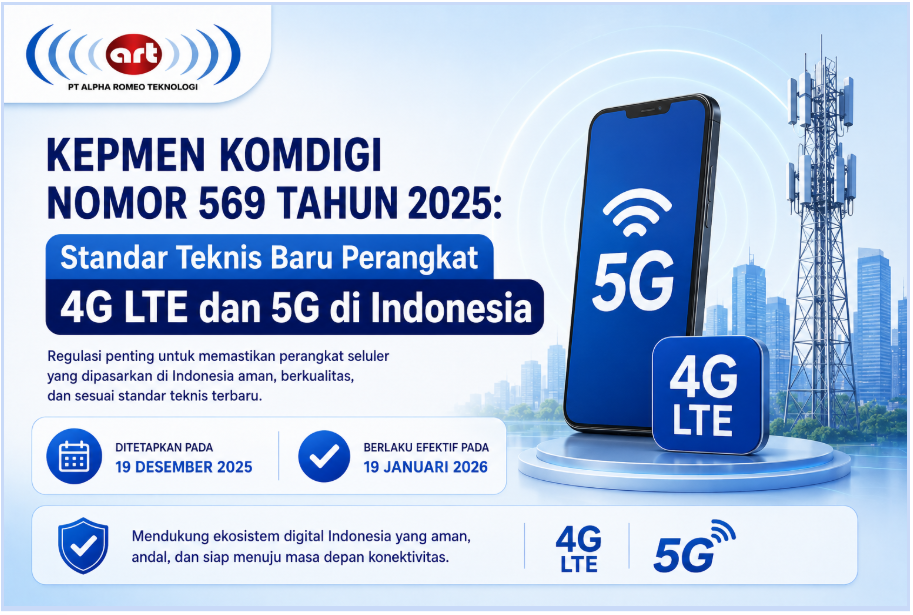
The Indonesian Government, through the Ministry of Communication and Digital Affairs (KOMDIGI), officially issued KOMDIGI Decree No. 569 of 2025 concerning the Technical Standards for Cellular Mobile Telecommunication Equipment and/or Devices Based on Long Term Evolution (LTE) and International Mobile Telecommunications-2020 (IMT-2020/5G) Technology Standards.
The government issued the regulation on December 19, 2025, and it became effective on January 19, 2026.
This Decree is important for the telecommunications industry because it introduces updated technical standards for 4G LTE and 5G devices marketed in Indonesia. Therefore, manufacturers, importers, distributors, and other companies involved with these devices need to understand the new requirements.
1. What Is 4G LTE?
4G LTE (Long Term Evolution) is the fourth generation of cellular network technology. Compared with 3G, it provides faster internet connections, lower latency, and more stable network capacity.
As a result, 4G LTE allows users to access various digital services more efficiently, including:
- HD video streaming
- Video conferencing
- Online gaming
- Cloud applications
- Internet of Things (IoT) connectivity
In Indonesia, 4G LTE remains an important cellular network technology. Many types of devices use this technology, including:
- Smartphones
- Modems
- Routers
- IoT devices
- Wireless CCTV devices
- Other telecommunication devices
Although 5G continues to expand, 4G LTE still plays an important role in Indonesia’s telecommunications infrastructure.
2. What Is 5G?
5G is the fifth generation of cellular network technology and the successor to 4G LTE.
Compared with previous generations, 5G offers higher data speeds, greater connection capacity, and much lower latency. In addition, the technology can support a much larger number of connected devices.
Because of these capabilities, 5G can support the development of technologies such as:
- Smart cities
- Autonomous vehicles
- Artificial intelligence
- Smart factories
- Internet of Things (IoT)
Therefore, 5G plays an important role in digital transformation across many industries.
3. Key Points of KOMDIGI Decree No. 569 of 2025
KOMDIGI Decree No. 569 of 2025 introduces updated technical standards for several types of LTE and 5G telecommunication equipment.
The regulation covers devices such as:
- 4G LTE devices
- 5G NR (New Radio) devices
- Subscriber stations
- Base stations
- Repeater devices
In addition, the regulation introduces several important technical requirements that companies need to consider.
a. Additional Frequency Bands
One of the important updates under the regulation is the addition of:
- LTE Band 41 (B41)
- 5G NR Band n41
These additional frequency bands support network compatibility and the continued development of 5G services in Indonesia.
As a result, manufacturers and device suppliers need to consider these frequency requirements when preparing compatible LTE and 5G products for the Indonesian market.
b. Certification and Technical Testing Requirements
Telecommunication devices must meet the applicable technical requirements before they can obtain DJID/SDPPI certification.
Depending on the type and technical characteristics of the device, the required tests may include:
- RF testing
- SAR testing
- EMC testing
- Unwanted emission testing
- Other applicable technical tests
Therefore, companies should identify the relevant technical standards and testing requirements before starting the certification process.
Proper preparation can help reduce problems during testing and certification.
c. TKDN Requirements
Certain telecommunication devices must also comply with applicable Domestic Component Level (Tingkat Komponen Dalam Negeri/TKDN) requirements.
These requirements include:
- 35% TKDN for certain HKT devices
- 40% TKDN for certain LTE base stations
However, companies should confirm which TKDN requirements apply to their specific products before starting the certification or market-entry process.
d. Re-Certification for Certain Devices
Some devices that already have certification may require re-certification when companies want to activate or add support for Band 41 or n41.
Therefore, manufacturers, importers, and certificate holders should review their existing device specifications and certification documents before enabling these additional frequency bands.
This review can help determine whether the device requires additional testing or a new certification process under the latest technical standards.
4. Why Did the Government Issue This Decree?
The Indonesian Government issued KOMDIGI Decree No. 569 of 2025 to update technical requirements in line with the development of LTE and 5G technologies.
In addition, the regulation aims to:
- Adapt technical standards to the development of LTE and 5G technology
- Support more effective use of the radio frequency spectrum
- Improve device compatibility with Indonesian telecommunications networks
- Support Indonesia’s digital transformation
- Align Indonesian technical standards with global technological developments
As cellular technology continues to develop, technical standards also need to adapt to new network capabilities and frequency bands.
Therefore, the new regulation provides an updated technical framework for LTE and 5G telecommunication devices in Indonesia.
5. What Regulation Did It Replace?
Before the government issued this regulation, KOMINFO Decree No. 352 of 2024 regulated the technical standards for LTE and 5G devices in Indonesia.
However, after KOMDIGI Decree No. 569 of 2025 came into effect, the government revoked the previous regulation.
Therefore, companies that manufacture, import, distribute, or certify LTE and 5G devices should refer to the latest technical requirements under KOMDIGI Decree No. 569 of 2025.
Companies should also review existing certifications and technical documentation to determine whether the new requirements affect their products.
Need Help with 4G LTE or 5G Certification?
PT. Alpha Romeo Teknologi Is Ready to Assist with Your Certification Process
Companies that manufacture, import, or distribute LTE and 5G devices may need assistance in understanding the applicable technical and certification requirements.
PT. Alpha Romeo Teknologi can provide assistance for:
- DJID/SDPPI/Postel Certification
- SAR regulation analysis
- Document and test report review
- Certification document evaluation
- Re-certification for cellular devices and tablets
- RF & EMC Testing
In addition, our team can help companies identify the applicable requirements for their telecommunication devices before starting the testing and certification process.
PT. Alpha Romeo Teknologi is ready to assist companies with telecommunication device certification and regulatory compliance in Indonesia.
#KOMDIGI #DJID #SDPPI #4G LTE #5G #5G NR #Band 41 #n41 #Type Approval #TKDN #RF Testing #EMC Testing #Telecommunication Certification #Telecommunication Regulation.